eu wil eigen veiligheidsraad en leger na waarschuwing over amerikaanse troepen
Brussel, zondag, 8 februari 2026.
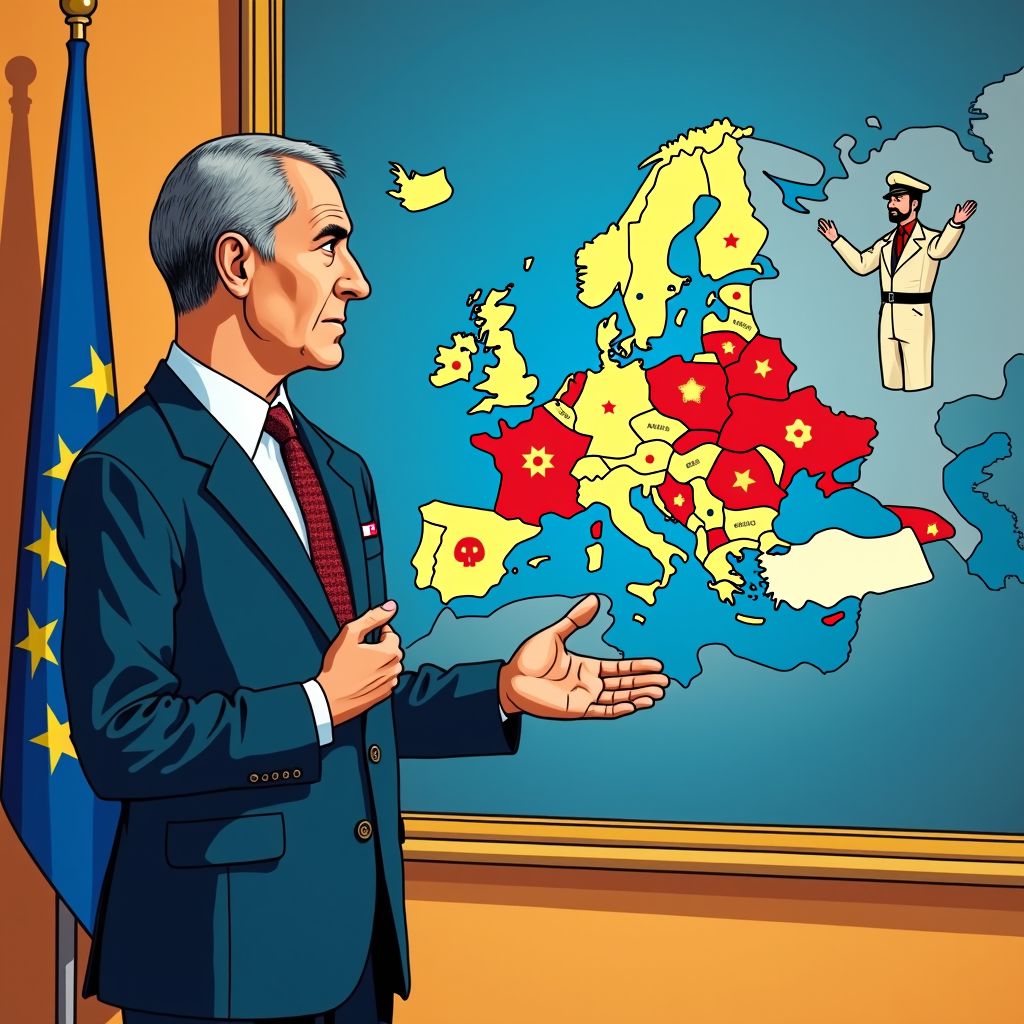
Europese Commissaris Andrius Kubilius legt een concreet plan voor ter oprichting van een Europese Veiligheidsraad. De raad moet snel kunnen beslissen over defensie tijdens crisissen. Hij noemt ook plannen voor een gemeenschappelijk Europees leger van 100.000 soldaten. Dat moet de strategische leegte opvangen als Amerikaanse troepen zich terugtrekken. Europa heeft nu meer geld uitgetrokken voor defensie dan Rusland. Toch blijft de afhankelijkheid van de Verenigde Staten een risico. Kubilius wijst erop dat transatlantische banden belangrijk zijn maar geen garantie bieden. De nieuwe structuur moet de Europese NATO-pijler versterken en Ukraine’s defensiepotentieel integreren. Landen werken al samen via groepen als E5+. De stap naar volledige militaire integratie is echter zonder precedent. Een eerdere poging in 1954 mislukte. Nu dringt de verslechterende geopolitieke situatie tot handelen aan.
brussels calls for urgent defence reform
Brussels is pushing for deeper military integration following a proposal by European Defence Commissioner Andrius Kubilius. On February 6, 2026, Kubilius released a formal document outlining the creation of a European Security Council and a standing European army of 100,000 troops [1]. The move responds to growing concern over the reliability of U.S. military presence in Europe, where approximately 100,000 American soldiers are currently stationed [6]. Kubilius stressed that while transatlantic ties remain vital, they cannot be seen as a guaranteed security framework [1].
a new council for european defence
The proposed European Security Council would feature permanent seats for the E5+ nations—Germany, France, Italy, Spain and Poland—with additional rotating memberships and representation from EU institutions [1]. This body would operate beyond crisis response, overseeing peacetime defence readiness and industrial coordination [1]. It would hold pre-authorised decision-making power during emergencies, subject to later approval by the European Council [2]. The idea mirrors earlier informal coalitions like the E5+ and G5+, which have coordinated military aid to Ukraine [2].
from ambition to common army
While a full European army remains a long-term vision, Kubilius advocates starting with a 100,000-strong multinational force to address immediate gaps [2]. Such a unit would help offset the strategic risk posed by a partial or total withdrawal of U.S. troops, which could remove nearly 100,000 personnel from European soil [1]. Historical attempts at military union, such as the 1954 European Defence Community, failed due to national resistance [2]. Today’s urgency stems from sustained Russian aggression and shifting American priorities, making prior hesitations harder to justify [2].
spending surpasses russia, capability lags
In 2025, combined EU defence expenditure exceeded Russia’s by $100 billion [1]. Despite this financial edge, military effectiveness is hampered by fragmentation across 27 national armies and disjointed procurement [1]. The EU’s NATO contingent includes 1.86 million active personnel, yet interoperability issues persist [1]. As analyst Max Bergman notes, the U.S. has historically opposed an independent European defence pillar within NATO, fearing duplication or weakened alliance cohesion [1]. This scepticism complicates efforts toward greater autonomy [1].
technology sovereignty and data control
Parallel to structural reforms, the EU is advancing technological independence. Plans are underway for a sovereign military data-sharing platform, excluding U.S. cloud providers [7]. Known as the Defense Artificial Intelligence Data Space, it aims to launch by 2030 [7]. Experts warn of risks like ‘kill switches’ embedded in foreign-owned systems that could disable European weaponry remotely [7]. While France pushes domestic procurement, harmonising standards across member states presents major political and logistical hurdles [7].
ukraine’s role in europe’s defence architecture
Kyiv’s battlefield innovation is shaping European defence strategy. Since 2022, Ukraine’s defence sector has grown by 218%, with 2025 revenues reaching €4 billion [4]. Its expertise in drone warfare and AI-driven command systems offers valuable lessons [4]. The EU recently opened its Defence Innovation Office in Kyiv and launched a joint task force on industrial cooperation [4]. Proposals exist to integrate Ukraine into the European Security Council, alongside non-EU allies like the UK and Norway [4].
political hurdles and neutrality questions
Not all EU members support deeper military integration. Austria, Cyprus, Ireland and Malta uphold traditional neutrality, potentially opting out of joint forces [2]. Hungary, under Viktor Orbán, currently blocks Ukraine’s accession talks, raising concerns about cohesion [2]. An upcoming April 2026 election there could shift Budapest’s stance [2]. Any new defence treaty may follow the Schengen model, allowing willing states to proceed intergovernmentally, sidestepping unanimous consent [2]. This approach balances ambition with political realism [2].
calculating the defence gap
The EU spent $100 billion more on defence than Russia in 2025 [1]. Assuming Russia’s budget was X, the EU’s total equals X + $100 billion. To determine the percentage difference: (100 / (X)) * 100. However, without Russia’s exact figure from sources, the relative increase cannot be fully calculated here [alert! ‘Russia’s 2025 defence budget not specified in provided sources’]. What is clear is the disparity in strategic agility despite superior funding [1].
Bronnen
- defence24.com
- www.friendsofeurope.org
- www.euronews.com
- www.martenscentre.eu
- www.heraldonline.co.zw
- informat.ro
- www.bankinfosecurity.com