Infantino's delicate dance with trump ahead of 2026 world cup
Washington, donderdag, 11 juni 2026.
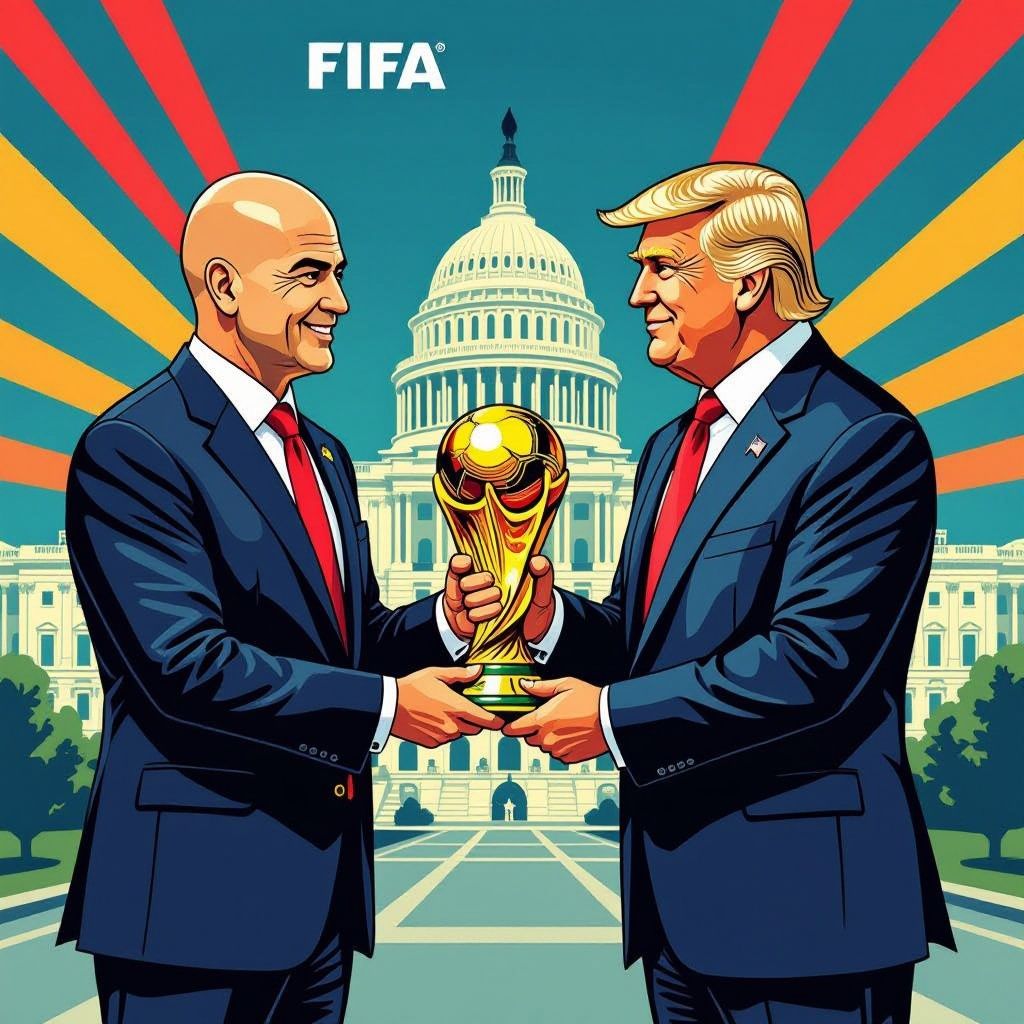
FIFA president Gianni Infantino sought closeness with former US president Donald Trump in Washington ahead of the 2026 World Cup. Video shows Infantino handing Trump the World Cup trophy, drawing criticism over FIFA’s neutrality. Days before the tournament, Somali referee Omar Abdulkadir Artan was denied entry to the US amid Trump’s harsh rhetoric against Somalis. Eleven of the 48 participating nations, mostly from the global south, faced strict visa controls. Critics argue Infantino sacrificed FIFA’s independence by appeasing Trump, undermining trust in football’s global governance. The controversy casts a shadow over the event’s opening day on June 11, 2026.
the meeting in washington
In early June 2026, FIFA president Gianni Infantino visited Washington, DC, where he met with former US president Donald Trump. Footage shows Infantino presenting Trump with a replica of the World Cup trophy during a public appearance. The gesture drew immediate scrutiny, as critics questioned the appropriateness of such symbolism weeks before the tournament began. Given Trump’s history of controversial statements on immigration, the optics raised alarms among human rights groups and football observers alike [1]. The visit underscored growing unease over FIFA’s relationship with the current US administration [2].
refused entry for somali referee
Just days before the kickoff, Somali referee Omar Abdulkadir Artan was denied entry at Miami International Airport. He was scheduled to officiate at the tournament and was one of 52 referees selected by FIFA [3]. US customs officials reportedly interrogated him about alleged ties to Al-Shabaab, according to media reports [1]. The incident occurred under the Trump administration, which maintains a travel restriction affecting Somalia. Artan’s denial sparked outrage, symbolizing broader access barriers faced by officials from several participating nations [2][3].
visa hurdles for multiple delegations
Eleven of the 48 participating nations, primarily from the global south, encountered significant visa obstacles ahead of the 2026 World Cup [2]. Thirteen members of Iran’s national delegation remained without visas as of June 10, 2026, and their supporters’ tickets were canceled [2]. Iraq’s vice-captain was held for seven hours upon arrival in Chicago [2]. These incidents contrast sharply with FIFA’s repeated assurances that everyone would be welcome across the three host nations—United States, Canada, and Mexico [1][2].
political rhetoric undermines neutrality
Former president Donald Trump referred to Somalis as “garbage” and “crooks,” remarks widely reported before the World Cup [2]. When asked about visa policies, Trump stated the administration was working “to make sure the right people come in” [4]. Andrew Giuliani, head of the White House World Cup Task Force, justified strict screening by citing terrorism risks linked to international events [2]. Such statements intensified criticism toward both US policy and FIFA leadership for failing to uphold the tournament’s claimed inclusivity [2][3].
infantino’s defensive stance
Facing questions from a BBC journalist, Gianni Infantino was challenged on whether he had lost control of the tournament. His reply avoided direct accountability. Instead, he posed a hypothetical: “Would you find it normal that FIFA dictates to the British government who to let in?” referencing a future Women’s World Cup in the UK [5]. Critics interpreted this as deflecting responsibility rather than defending access for current participants [2][5]. The exchange highlighted the weakening authority of FIFA over host-nation decisions [2].
erosion of fifa’s institutional power
Historically, FIFA wielded strong leverage over host countries. For the 2018 World Cup in Russia, FIFA successfully pushed for visa-free access and reversed media bans [2]. However, the 2026 edition marks a shift—the US holds greater power in the arrangement, reducing FIFA’s influence [2]. Analysts note this imbalance stems from declining interest among potential hosts due to financial and logistical burdens [2]. With fewer viable bidders, FIFA now depends more on nations like the US, limiting its ability to enforce conditions [2].