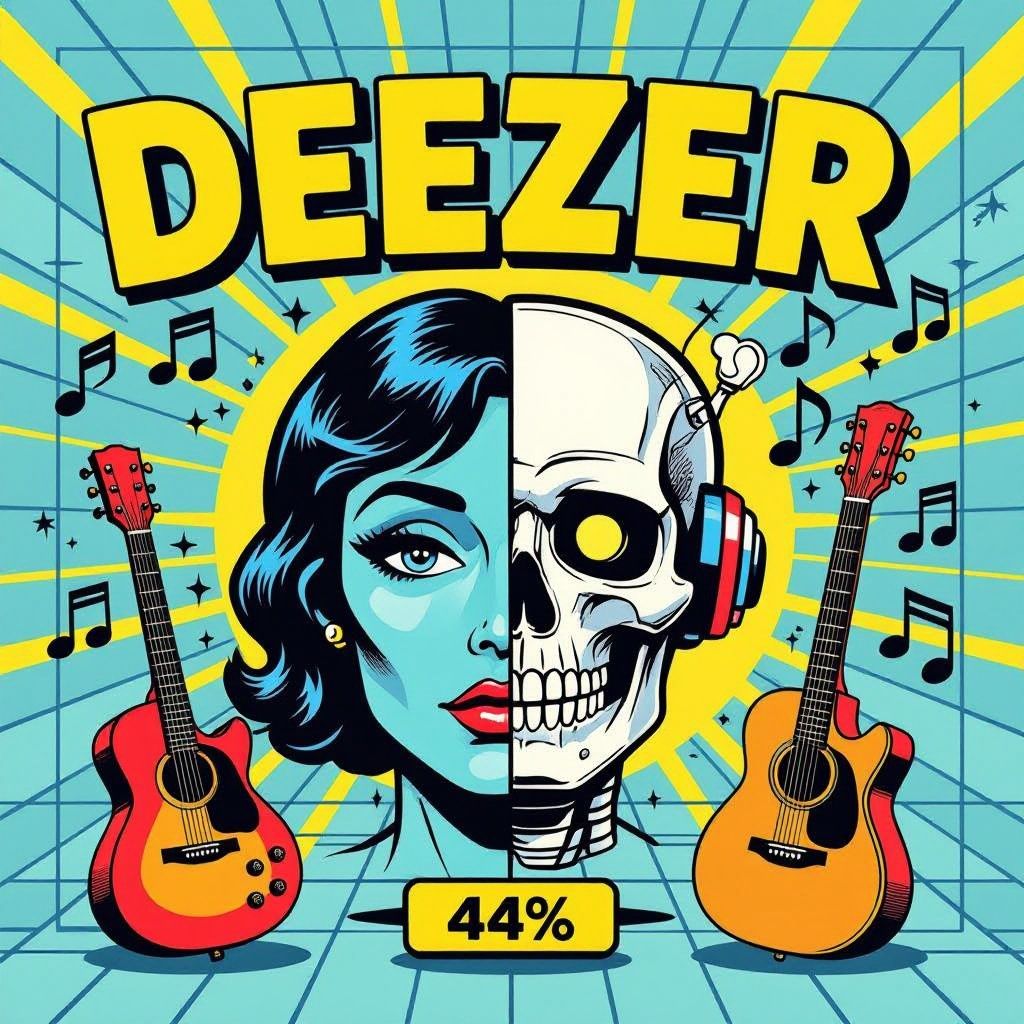
44 percent of new music on deezer is now ai-generated
Parijs, maandag, 20 april 2026.
Deezer reveals that 44 percent of newly uploaded tracks are fully generated by artificial intelligence. That amounts to roughly 75,000 AI songs added each day. While AI music floods the platform, it accounts for only 1–3% of total streams. Most of these plays are flagged as fraudulent, with 85% blocked for suspected bot activity. The rise raises serious concerns about artist royalties and copyright. Human creators risk losing income as AI content inflates upload numbers. Deezer labels AI tracks and blocks them from recommendations and high-resolution storage. Its detection system, active since mid-2025, has already tagged over 13 million AI files. CEO Alexis Lanternier calls for industry-wide action to protect creators. Eighty percent of surveyed listeners agree AI music should be clearly marked. The move highlights growing pressure on streaming platforms to ensure transparency. Artists warn automation could undermine creative integrity. The debate intensifies as AI reshapes music’s future.
explosive growth of ai uploads on deezer
As of April 20, 2026, 44% of all newly uploaded tracks on Deezer are fully generated by artificial intelligence [1]. This represents approximately 75,000 AI-generated tracks added daily to the platform [2]. The volume has increased dramatically since early 2025, when only 10,000 AI tracks were uploaded per day [3]. The sharp rise underscores how quickly AI-generated music is entering mainstream digital ecosystems. The growth rate from January 2025 to April 2026 reflects an explosive increase [3].
fraudulent streams and financial implications
Despite the influx of AI-generated content, such music accounts for only 1–3% of total streams on Deezer [1]. Alarmingly, up to 85% of these streams are flagged as fraudulent and blocked by the platform [4]. These fraudulent plays often originate from bots designed to manipulate royalty distributions [4]. By inflating play counts artificially, bad actors attempt to divert payments away from human artists. This poses a direct threat to creator incomes across the global music landscape [4].
industry response and technological safeguards
Deezer launched its proprietary AI detection technology in June 2025, becoming the first major streaming service to independently identify AI-generated audio [5]. Since then, the platform has detected and tagged over 13.4 million AI tracks [5]. Tracks confirmed as AI-generated are excluded from algorithmic recommendations and editorial playlists [6]. High-resolution versions of AI tracks are no longer stored, limiting their quality and appeal [1]. These technical barriers aim to preserve space for human-created music [6].
calls for transparency and artist protection
Alexis Lanternier, CEO of Deezer, emphasized that AI-generated music is no longer a marginal phenomenon [7]. He urged the broader music ecosystem to act collectively in defending artist rights and ensuring fan transparency [7]. An Ipsos survey commissioned by Deezer found that 80% of respondents want AI music clearly labeled [8]. Furthermore, 97% of participants could not distinguish AI music from human-made works in a blind test, highlighting the difficulty of identification [8].
labeling debates and chart eligibility
Public opinion shows strong support for disclosure of AI authorship in music [8]. According to the same Ipsos study, a majority of listeners oppose allowing AI-generated songs to appear in official music charts alongside human creations [8]. This sentiment aligns with growing unease among working artists about authenticity and credit [8]. Platforms like Qobuz have responded by implementing AI charters that prioritize human creativity, while others rely on voluntary distributor disclosures [9].
economic threats to human musicians
Industry analysts project that up to 25% of music creators’ income could be at risk due to AI manipulation by 2028 [1]. Royalty pools depend on accurate streaming metrics, which bot-driven plays distort significantly [4]. Even minimal listener engagement with AI tracks can disrupt revenue models if those plays are fraudulent [1]. Protecting the economic foundation of music creation has become urgent as automation accelerates across production and distribution layers [GPT].
competitive approaches to ai regulation
Other major platforms have adopted varied responses to AI-generated content [9]. Spotify supports the DDEX metadata standard for disclosing AI involvement but relies largely on distributor compliance [9]. Apple Music uses Transparency Tags based on label reporting rather than independent detection [9]. In contrast, Deezer licenses its detection technology commercially through its ‘Deezer for Business’ division, offering it to organizations like Sacem and EJI [5].
Bronnen
- www.musicbusinessworldwide.com
- tech.yahoo.com
- mezha.net
- medium.com
- fr.linkedin.com
- tech.yahoo.com
- www.linkedin.com
- mezha.net
- medium.com