canadese premier roept op tot alliantie van middelgrote landen tegen grootmachten
Ottawa, vrijdag, 6 februari 2026.
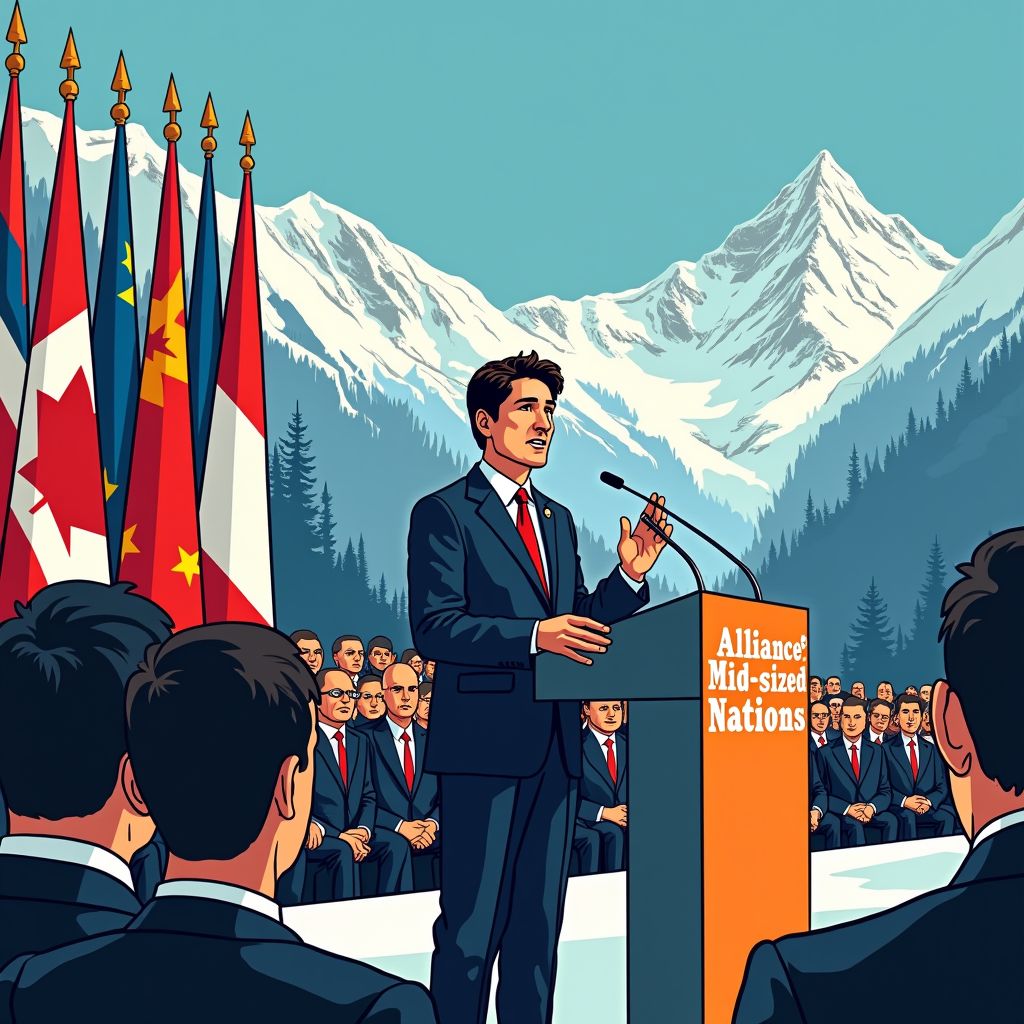
De Canadese premier heeft een nieuwe coalitie van middelgrote landen voorgesteld om zich beter te kunnen weren tegen de invloed van wereldmachten. Dit plan komt op een moment van toenemende geopolitieke spanningen en moet voorkomen dat landen als Canada politiek worden gemarginaliseerd. De visie lijkt op eerdere Europese diplomatieke initiatieven en kan gevolgen hebben voor het buitenlands beleid van de Europese Unie. De oproep volgt op een toespraak in Davos waarin de premier waarschuwde dat oude veiligheidsveronderstellingen niet langer gelden. Hij benadrukte dat samenwerking essentieel is om zelfstandig te blijven in een verdeelde wereld.
canada’s call for a coalition of middle powers
Canadian Prime Minister Mark Carney has called for the formation of a robust alliance among middle powers to resist undue influence from dominant global actors. This strategic move aims to prevent smaller and mid-sized nations from being politically marginalized amid rising geopolitical tensions [0]. The appeal follows heightened friction between Canada and the United States, particularly after President Donald Trump dismissed Canada’s autonomy, stating it “lives because of the United States” [0]. Such dynamics underscore growing pressure on moderate states to assert greater agency in foreign affairs.
davos declaration sets new foreign policy direction
At the World Economic Forum in Davos on January 21, 2026, Prime Minister Carney emphasized that old assumptions about security through geographic advantage or alliance membership no longer hold [0]. He argued that middle powers must unite to overcome systemic vulnerabilities, noting that relying on great powers is no longer tenable [0]. According to Carney, integration across trade, energy, security, and communication corridors enables these nations to reshape global structures collectively [1]. His speech positioned Canada as a proactive player in forging new multilateral frameworks beyond traditional dependencies.
us backlash and internal canadian responses
Following Carney’s remarks, the US administration intensified rhetorical attacks, with President Trump deriding him as ‘Governor Carney’—a pointed diminishment of Canada’s sovereign status [0]. Simultaneously, US State Department officials engaged in covert talks with the Alberta Prosperity Project, a separatist faction advocating for Alberta’s independence [0]. Analysts interpret this as an attempt to exploit regional divisions within Canada [0]. Domestically, former Saskatchewan Premier Brad Wall acknowledged the logic behind diversifying trade relationships but cautioned that rhetoric must translate into actionable policy to withstand American economic pressure [2].
historical parallels and european resonance
Carney invoked the European Union as a six-decade-long precedent of medium-sized states pooling sovereignty for enhanced global clout [0]. Columnist Pascal Riché of Le Monde observed that this vision aligns closely with longstanding European diplomatic ambitions [0]. While geographically distant, the implications extend to the European Union’s evolving foreign posture, potentially influencing how Brussels approaches strategic autonomy [0]. With 75 percent of Canadian exports still destined for the US market, the push for multipolarity faces immediate structural hurdles [2]. Yet the precedent of EU cohesion offers a conceptual roadmap for broader interregional cooperation among likeminded democracies.
trade dependencies and shifting alliances
Canada’s economic vulnerability stems from deep integration with the US economy, exemplified by 75 percent of its exports flowing southward [2]. During his tenure, former Saskatchewan Premier Brad Wall reduced provincial reliance on the US market from 60 to below 50 percent through targeted diversification efforts [2]. Building on this, Carney’s administration seeks to expand ties beyond North America, including high-level engagements with China and Qatar [1]. A recently launched diplomatic mission in Greenland signals Ottawa’s intent to strengthen Arctic coordination on climate and defense matters amid intensifying great power competition [3].