trump hits back with new 10% global tariff after supreme court defeat
Washington D.C., zaterdag, 21 februari 2026.
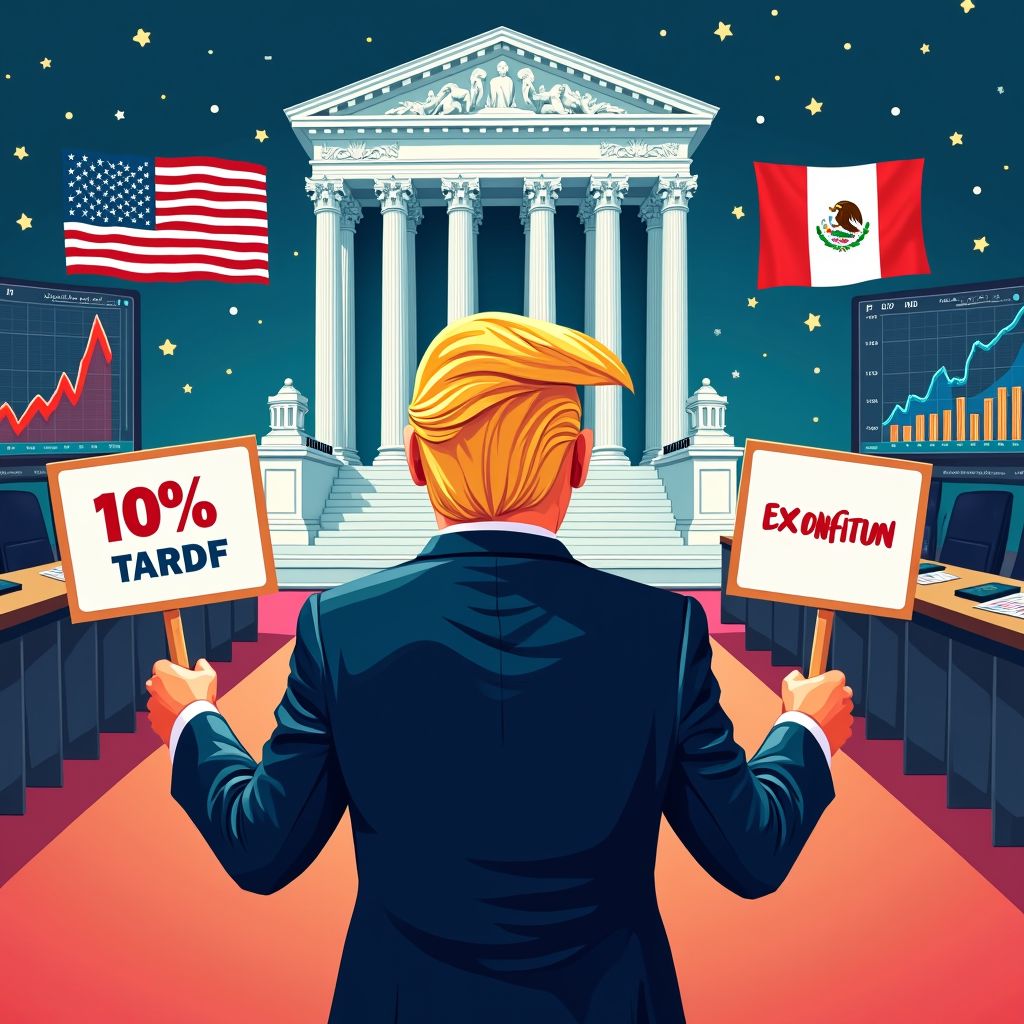
The u.s. supreme court has struck down president donald trump’s sweeping tariff powers in a 6-3 ruling. the court found he lacked legal authority to impose broad tariffs under emergency laws. hours later, trump unveiled a new 10% global import tax using different legislation. canada and mexico are largely shielded if goods meet csuma rules. the swift reversal keeps pressure on global markets. allies express cautious relief but face fresh uncertainty. the move sidesteps congress’s constitutional role in taxation. over $130 billion in prior tariffs had already been collected. businesses now await implementation details and potential fallout for trade stability.
supreme court strikes down trump’s emergency tariffs
In a landmark 6-3 decision, the U.S. Supreme Court ruled that former President Donald Trump overstepped his authority by imposing broad tariffs under the International Emergency Economic Powers Act (IEEPA) [1]. Chief Justice John Roberts wrote the majority opinion, stating the president cannot unilaterally impose tariffs of unlimited scope without clear congressional authorization [1]. The ruling invalidates much of Trump’s expansive tariff framework introduced in 2025, marking a significant check on executive power in trade policy [1]. While some sector-specific tariffs remain, the decision dismantles a key pillar of Trump’s economic agenda [1].
trump responds with new 10% global tariff measure
Hours after the court’s decision, Trump issued an executive order establishing a new 10% global import tariff under Section 122 of the Trade Act of 1974 [2]. This bypasses the IEEPA restrictions by invoking alternative statutory authority, allowing tariffs for up to 150 days under claimed balance-of-payments concerns [2]. The new levy applies broadly but exempts goods from Canada and Mexico complying with CUSMA rules [2]. Critical minerals, energy products, and pharmaceuticals are also excluded from the new duty [2]. Industry analysts note this shift reflects strategic recalibration rather than retreat [2].
allies react with cautious optimism and concern
European Union officials welcomed the curbing of unilateral tariffs but stressed the need for stable transatlantic trade relations [4]. French President Emmanuel Macron remarked that judicial oversight strengthens the rule of law [1]. The UK government pledged continued support for British businesses navigating evolving U.S. trade policy [1]. Canadian trade minister Dominic LeBlanc affirmed the decision validates Ottawa’s long-standing objection to the earlier tariffs [2]. Despite exemptions, regional manufacturers warn ongoing uncertainty threatens investment planning and supply chain resilience [2].
business groups highlight persistent uncertainty
The British Chambers of Commerce cautioned that despite the court victory, “murky waters” persist for exporters regarding potential refunds and compliance logistics [1]. Swissmem, representing Switzerland’s technology sector, called the ruling positive but insufficient without binding agreements [1]. The International Chamber of Commerce emphasized the urgent need for clear guidance from U.S. trade authorities to minimize litigation risks and administrative costs [1]. Legal experts anticipate prolonged disputes over the repayment of approximately $134 billion collected under the invalidated measures [1].
legal and economic implications unfold
Legal scholars interpret the judgment as reinforcing the “major questions doctrine,” limiting presidential power on transformative economic issues absent explicit legislative approval [1]. With over $134 billion in tariffs already collected from more than 301,000 importers, questions loom about restitution processes [1]. Lower courts will soon address whether those payments must be returned [1]. Economists suggest the rapid replacement of tariffs signals continuity in protectionist goals despite judicial setbacks, keeping financial markets vigilant [1].