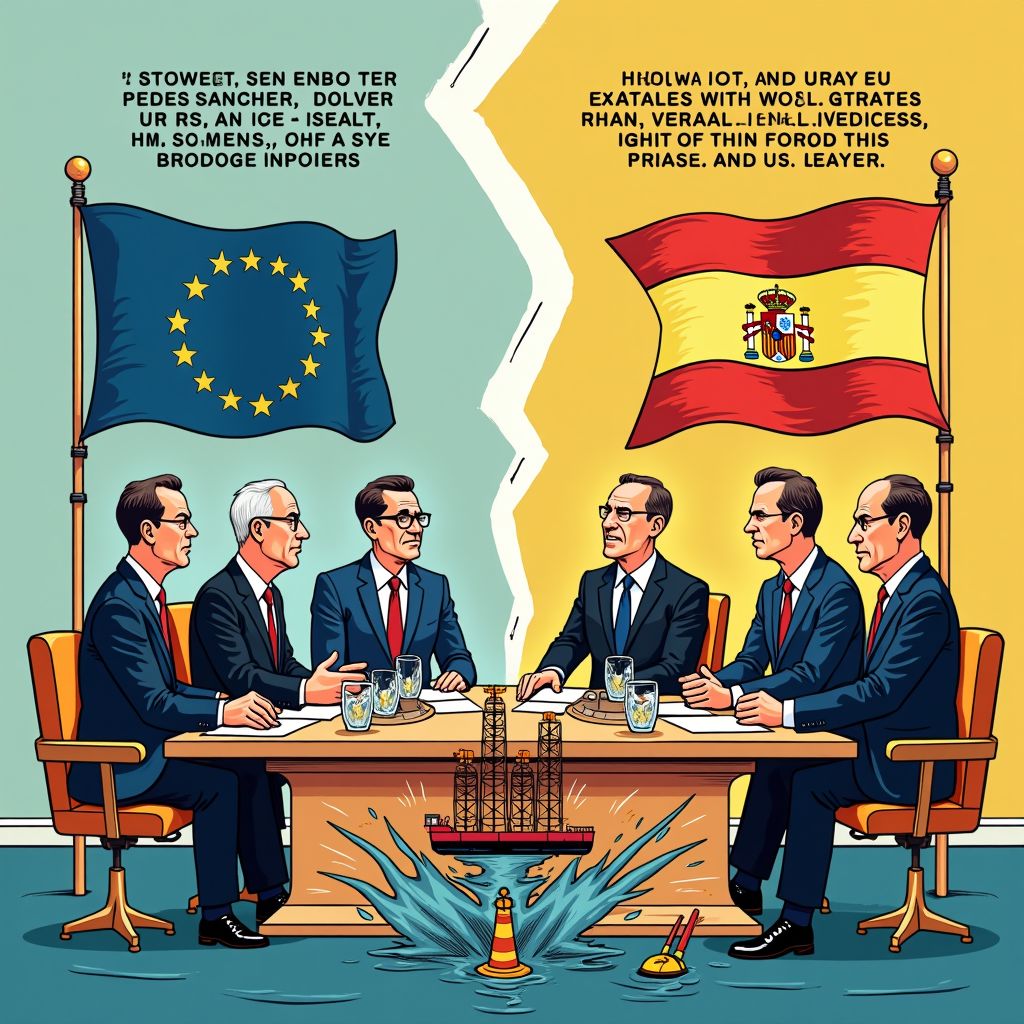
eu verdeeld over iraan-blitz: spanje breekt met west
Brussel, dinsdag, 3 maart 2026.
De Europese Unie raakt ernstig verdeeld over de militaire escalatie in het Midden-Oosten. Terwijl de meeste lidstaten Iran veroordelen voor willekeurige aanvallen, durft alleen Spanje ook de acties van de VS en Israël te bekritiseren. Premier Sánchez noemt die ingrepen een gevaarlijke escalatie. Noorwegen sluit zich hierbij aan. Diplomatieke bronnen wijzen op risico’s van een bredere oorlog. De EU vreest een nieuwe energiecrisis. Qatar stopt al met lng-productie. Economiedeskundigen waarschuwen dat de timing voor Europa niet slechter had kunnen zijn. Kernwapengevaar blijft hoog. De druk op Brussel om één front te vormen neemt toe.
divided stance on middle east escalation
The european union faces internal divisions over the latest military escalation in the middle east. While most eu countries condemn iran’s retaliatory strikes, spain stands out by also criticizing prior attacks by the united states and israel. spanish prime minister pedro sánchez described these actions as dangerous escalations undermining international order [1]. norway, though not an eu member, echoes this sentiment, urging compliance with international law from all parties involved [2]. such divergent positions highlight challenges in forming a unified foreign policy approach amid rising regional tensions [1][2].
common concerns despite differing views
Despite differences in blame attribution, key themes unite europe’s response. all emphasize urgent de-escalation, diplomacy, and protecting civilians [3]. there is widespread alarm over potential nuclear risks and destabilizing activities linked to iran’s ballistic missile program [3]. european leaders stress the need for full compliance with international atomic energy agency requirements [3]. preserving freedom of navigation, particularly near strategic chokepoints like the strait of hormuz, remains critical [3]. the eu reaffirms its dedication to regional stability and civilian protection amidst growing uncertainty [3].
economic vulnerability intensifies pressure
Europe’s economy appears especially vulnerable to prolonged conflict in the middle east. according to ing economists, the timing could hardly be worse as the eurozone was just beginning to recover from earlier setbacks [4]. new u.s. import tariffs had already weakened growth prospects before energy supply fears emerged [4]. qatar has suspended liquefied natural gas (lng) production due to iranian threats, exacerbating price volatility [4]. disruptions to critical shipping lanes would further strain markets, recalling the 2021–2023 energy crisis but under less favorable seasonal conditions [4].
diplomatic initiatives and military warnings
high representative kaja kallas issued a formal eu statement calling for maximum restraint from iran and demanding an immediate halt to military operations [3]. the bloc announced additional sanctions targeting iran’s nuclear ambitions and regional interference [3]. simultaneously, france, germany, and the uk—known as the e3—warned of defensive military measures if iranian rocket or drone capabilities endanger their personnel or allies [5]. these nations labeled iran’s cross-border attacks as arbitrary and disproportionate, stressing collective defense commitments in the region [5].
support for iranian civil society
while condemning state-led aggression, the eu continues to voice strong support for the iranian people’s right to self-determination and basic freedoms [3]. officials acknowledge public discontent toward authoritarian rule and back peaceful movements advocating democratic reform [3]. this position aligns with broader western narratives emphasizing human rights protections amid geopolitical instability [1][3]. however, balancing criticism of tehran’s regime with non-intervention principles complicates diplomatic messaging. the path forward depends heavily on multilateral coordination and sustained dialogue channels [3].