utrecht takes lead as national home values surge
Utrecht, woensdag, 17 juni 2026.
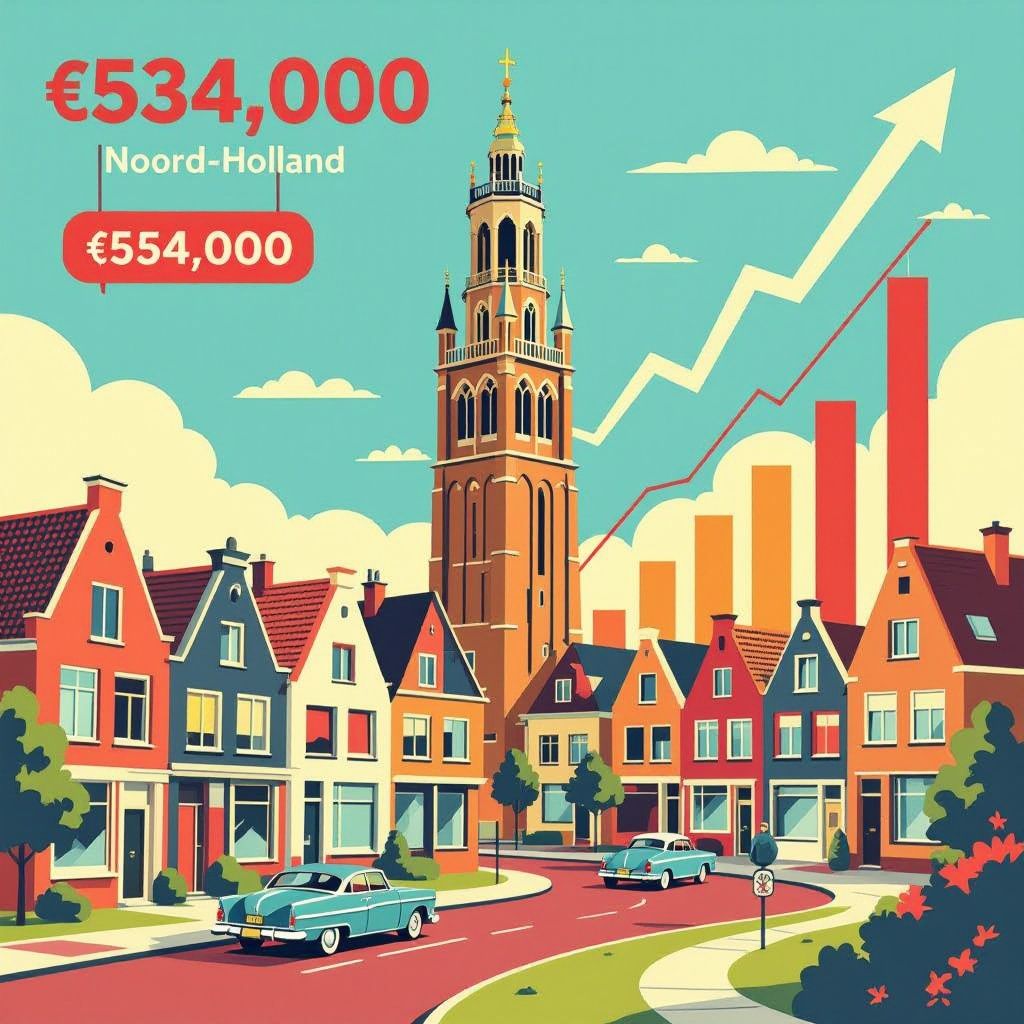
The average WOZ-waarde of homes in the Netherlands reached €439,000 in 2026, marking a 10.3 percent increase from last year. This sharp rise reflects continued pressure on the housing market due to limited supply and strong demand. For the first time, Utrecht surpassed Noord-Holland as the province with the highest average property value, now at €534,000. The shift highlights changing dynamics across regions. These updated valuations directly affect onroerende zaakbelasting and other fiscal obligations for homeowners. While values rose nationwide, growth varied widely between municipalities. The figures are based on market conditions from January 2025, underscoring the delayed but lasting impact of recent price trends.
national trend confirms sustained growth
The average WOZ-waarde of residential properties in the Netherlands has risen to €439,000 in 2026. This represents a 10.3 percent increase compared to 2025, when the average stood at €398,000 [1]. The percentage change is calculated as 10.302 [1][2]. This marks the eleventh consecutive annual increase in property values [1][3]. Growth accelerated compared to previous years, following increases of 5.3 percent in 2025 and 2.7 percent in 2024 [7]. Despite slower growth than the 16.1 percent peak seen in 2023, the upward trajectory remains intact [2][7].
regional shifts redefine housing leadership
For the first time, Utrecht has overtaken Noord-Holland as the province with the highest average WOZ-waarde. Properties in Utrecht now carry an average valuation of €534,000, surpassing Noord-Holland’s €526,000 [7]. This shift underscores evolving regional dynamics driven by persistent demand in central urban areas [2][7]. Province-wide, Limburg recorded the strongest growth at nearly 11.9 percent, reaching €348,000 [1][3]. In contrast, Zeeland experienced the lowest provincial increase at 7.2 percent, with its average WOZ-waarde rising to €342,000 [6][7].
municipal disparities highlight local markets
Significant variation exists between municipalities. The Groningse municipality of Pekela saw the largest jump, with a 19 percent increase lifting its average WOZ-waarde to €254,000 [1][3]. At the opposite end, Texel reported the smallest rise at just 2.5 percent, bringing its average to €416,000 [7]. The highest municipal valuations remain concentrated in affluent parts of North Holland. Laren leads with an average of €993,000, closely followed by Bloemendaal at €988,000 [1][7]. Heerlen in Limburg holds the lowest average at €238,000 [1][7].
tax implications amplify household impact
The WOZ-waarde serves as the foundation for several key taxes affecting homeowners. Municipalities use it to calculate the onroerende zaakbelasting (OZB), waterschapstoeslagen, and the eigenwoningforfait in Box 3 income taxation [6][7]. Recent court rulings confirm that the official WOZ assessment determines tax liability, even if later sale prices differ significantly [5]. With values rising faster than incomes in many areas, the increase places additional financial pressure on households regardless of actual selling activity [GPT].
data methodology explains timing gap
The 2026 WOZ-waardes reflect market conditions as of January 1, 2025, creating a reporting lag of approximately thirteen months [4]. Tax assessors base valuations on transaction data, new construction, demolitions, and rental market developments from that reference date [1][3]. This delay means current assessments capture the robust price environment of 2024 rather than more recent stabilization signals [4]. As a result, perceived discrepancies may arise between official valuations and contemporary market sentiment [4].
Bronnen
- www.ad.nl
- www.nu.nl
- www.welingelichtekringen.nl
- www.meijsenalink.nl
- www.taxlive.nl
- www.omroepzeeland.nl
- www.headliner.nl