pakistan stelt vredesplan voor om vs-israël oorlog met iran te stoppen
Islamabad, maandag, 6 april 2026.
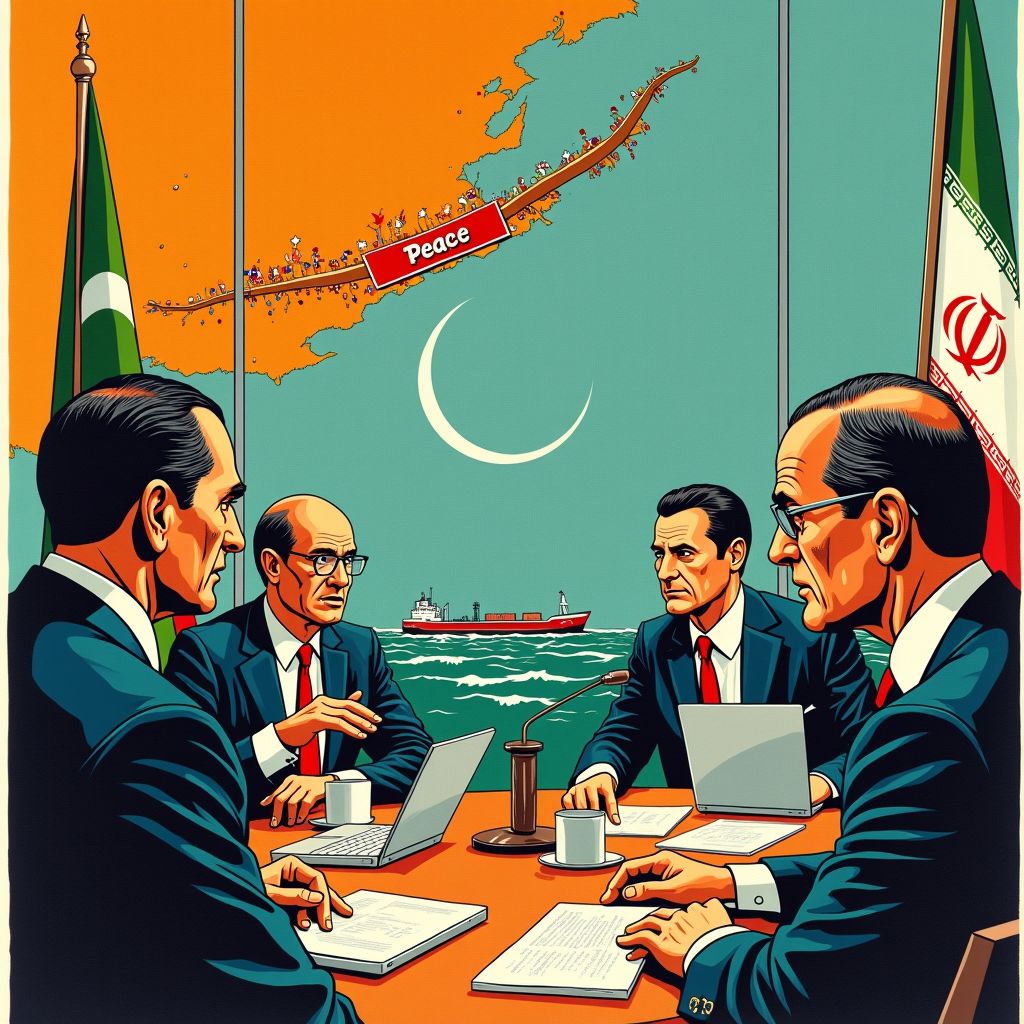
Pakistan heeft een tweeledig vredesplan ingediend om de escalerende oorlog tussen de Verenigde Staten, Israël en Iran te stoppen. Het plan, bekend als het ‘Islamabad Accord’, voorziet in een onmiddellijke wapenstilstand gevolgd door structurele onderhandelingen binnen vijftien tot twintig dagen. Een cruciaal punt is de heropening van de Straat van Hormuz, waar meer dan twintig procent van de wereldwijde olie- en gasstromen doorheen gaat. Iran keurt een tijdelijke wapenstilstand af en wil alleen praten over een permanente oplossing. De internationale gemeenschap volgt de diplomatieke inspanningen van Pakistan nauwlettend vanwege de impact op de mondiale energievoorziening.
pakistan takes lead in tense diplomacy
Pakistan has stepped into a pivotal diplomatic role amid escalating hostilities between the United States, Israel, and Iran. On April 6, 2026, Field Marshal Asim Munir, Pakistan’s army chief, led intense overnight discussions with U.S. Vice President JD Vance, special envoy Steve Witkoff, and Iranian Foreign Minister Abbas Araghchi [1]. The urgency stems from a rapidly deteriorating situation following Israeli airstrikes on Iran’s South Pars Petrochemical Plant, which killed at least 34 people earlier that day [1]. With global energy markets on edge, Pakistan positioned itself as a neutral broker capable of facilitating dialogue where traditional channels have failed [1].
the islamabad accord unveiled
The proposed framework, named the ‘Islamabad Accord’, outlines a two-phase approach to ending the conflict [1]. First, an immediate ceasefire would halt military operations and allow for the reopening of the strategically vital Strait of Hormuz [2]. Second, formal negotiations lasting 15 to 20 days would aim to establish a durable political settlement [2]. Part of the package includes Iranian commitments on nuclear non-proliferation in exchange for the lifting of sanctions and release of frozen assets [1]. Pakistan emphasized that all components of the deal must be agreed upon simultaneously, underscoring the fragility of trust between the parties [1].
iran resists temporary measures
Despite international pressure, Iran has firmly rejected any arrangement deemed temporary [1]. A senior Iranian official confirmed that Tehran would not agree to reopen the Strait of Hormuz as part of a short-term ceasefire [1]. Iranian Foreign Ministry spokesman Esmaeil Baghaei dismissed previous U.S. proposals as ‘extremely ambitious, unusual, and illogical’ [1]. Iran insists on legally binding guarantees against future military actions by the U.S. and Israel before considering disengagement [2]. This stance reflects deep-seated skepticism about American intentions, particularly given public statements from former President Donald Trump threatening severe consequences if the strait remained closed beyond April 7, 2026 [1].
global implications of blocked trade routes
More than 20% of globally traded oil and liquefied natural gas passes through the Strait of Hormuz, making its closure a critical threat to energy security [2]. The ongoing blockade has already triggered volatility in global markets and increased insurance premiums for commercial shipping [4]. Further disruption looms as Iranian parliamentary speaker Mohammad Bagher Ghalibaf questioned the volume of essential goods—oil, LNG, wheat, rice, fertilizers—passing through the Bab el-Mandeb Strait, suggesting possible retaliatory action there [4]. Analysts warn prolonged instability could reshape global trade patterns and accelerate efforts to bypass traditional chokepoints [4].
china backs pakistan’s diplomatic push
China has aligned itself with Pakistan’s mediation effort, jointly promoting a five-point peace plan focused on ceasing violence, protecting maritime commerce, and restoring diplomatic dialogue [4]. While officially neutral, China stands to benefit economically and geopolitically from positioning itself as a responsible global actor amidst Western entanglement in Middle Eastern conflicts [4]. Beijing’s growing trade with Gulf states—valued at $257 billion in 2024 alone—underscores its vested interest in stable shipping lanes [4]. Through state media messaging, China contrasted its peace-oriented posture with what it describes as U.S. militarism, framing restraint as true strength [3].