Europa worstelt met eigen verdediging zonder Amerikaanse steun
Brussel, zondag, 1 maart 2026.
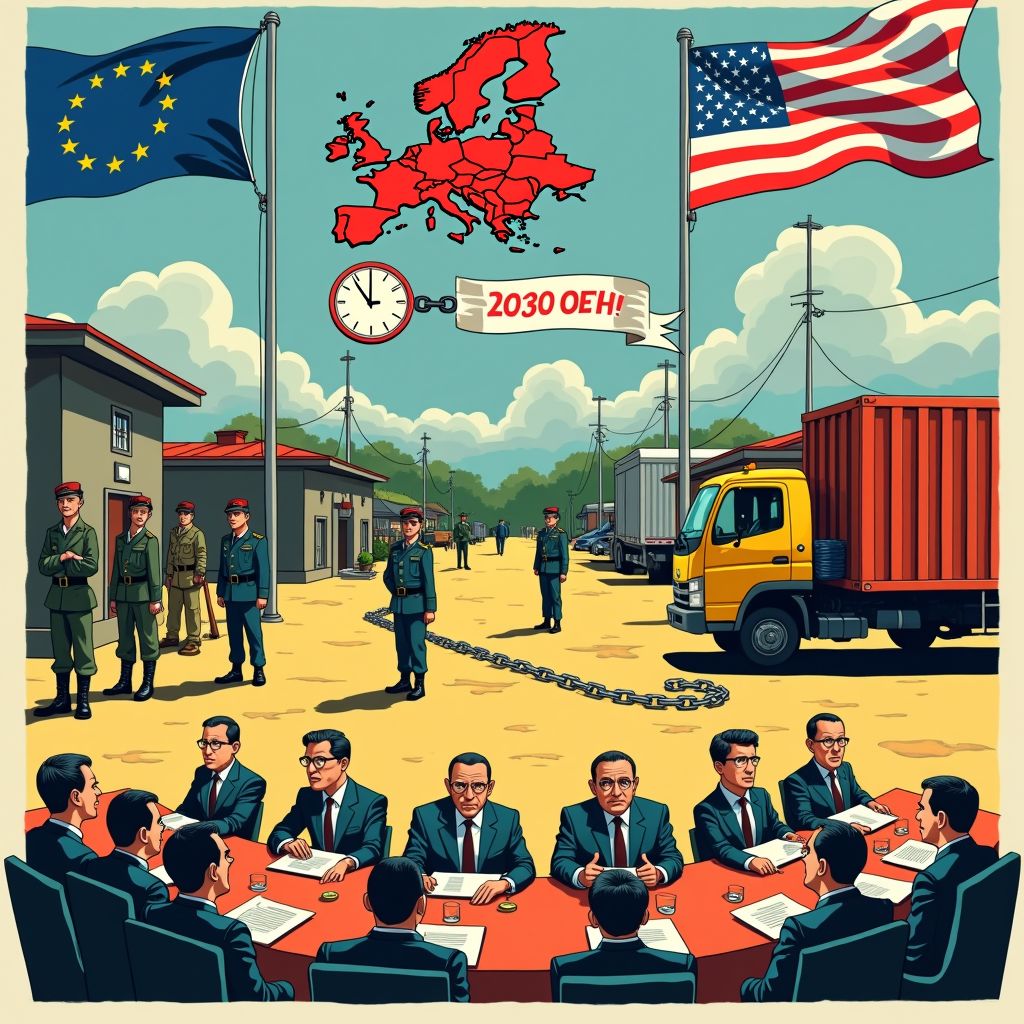
Europese landen beseffen steeds meer dat ze afhankelijk zijn van de Verenigde Staten voor hun verdediging. Zelfs met recente investeringen in luchtverdediging en militaire integratie blijft Europa achter bij de benodigde capaciteiten om zichzelf te beschermen tegen een mogelijke Russische agressie. Er ontstaat paniek over tekorten in logistiek en strategisch transport. Deskundigen waarschuwen dat Europa pas rond 2030 echt zelfstandig zou kunnen opereren. Terwijl de NAVO-wapenleveranties aan Oekraïne dalen, groeit de druk op Europese regeringen om sneller te innoveren en samen te werken. De kernvraag is geen technologie meer, maar politieke wil. Zonder die wil blijft de gezamenlijke veiligheid kwetsbaar.
pressure mounts on european defense coordination
European defense planners face intensifying scrutiny amid concerns over their ability to repel potential Russian aggression without U.S. assistance. Recent assessments indicate significant deficiencies in critical domains such as air and missile defense, logistics, and strategic mobility. Although several nations have increased procurement of short-range air defense systems, acquiring €18 billion worth since 2022 compared to €7.5 billion in the prior four years [1], the continent still lacks cohesive command structures and scalable production capacities [2]. Analysts stress that even modest improvements require deeper political alignment among EU members [3].
critical gaps persist despite increased spending
While investment in air defense has surged, with European countries ordering €18 billion in short- and very-short-range systems since 2022 [1], experts warn this does not address larger systemic vulnerabilities. Frédéric Mauro of IRIS France stated Europe could counter cruise missiles and hypersonic threats like Kinzhal within two years but remains defenseless against ballistic missiles such as Oreshnik [1]. Logistical shortcomings remain acute, especially in strategic transport and maintenance infrastructure. Interoperability issues plague joint operations, slowing deployment timelines essential for rapid escalation scenarios [2][3].
strategic autonomy hindered by industrial limitations
Europe’s ambition for strategic autonomy is constrained by industrial bottlenecks and fragmented supply chains. Despite initiatives like the European Defence Industrial Strategy aiming for 50% EU-sourced equipment by 2030, current production cannot match wartime demand [2]. Ukraine’s estimated annual requirement of 4,800 air defense interceptors exceeds European manufacturing output [4]. Artillery shell production stands at 1.5 million per year by Rheinmetall alone, contributing toward an EU-wide target of 2 million shells annually by 2027 [4]. However, missile and electronic warfare component shortages persist [2][4].
command and control remains u.s.-dependent
Battlefield command and control (C2) remains heavily reliant on American assets, including satellite communications and deep-strike intelligence [1]. Only six of sixteen surveyed experts believe Europe can develop adequate long-range strike capabilities within two years; half anticipate delays beyond five years [1]. Projects like JEWEL—a Franco-German early warning system—are not expected to become operational until the early 2030s [1]. NATO currently depends on 14 U.S.-provided E-3A AWACS aircraft, though Sweden and France have ordered Saab GlobalEye systems to eventually supplement coverage [1].
political momentum grows amid rising threats
Heightened geopolitical tensions have spurred political action across Europe. The EU introduced the Defence Readiness Omnibus in mid-2025, streamlining procurement and setting a fast-track 60-day approval process for defense infrastructure [2]. Financial mechanisms like the SAFE regulation enable long-term loans, while the European Defence Industry Programme allocates €1.5 billion to boost industrial readiness [2]. Meanwhile, the UK committed £500 million to Ukrainian air defense in late February 2026, signaling continued bilateral involvement [5]. Still, skepticism persists regarding implementation speed and funding adequacy [3][5].
offensive capabilities seen as essential deterrent
Defense specialists increasingly argue that purely defensive postures are insufficient to deter Russian aggression. Guntram Wolff of Bruegel stressed that effective deterrence requires offensive tools, specifically long-range strike capabilities [1]. Several nations are advancing such projects: Norway acquired Chunmoo rockets with 500 km range, while the UK and Germany jointly develop a 2,000 km-range deep strike weapon [1]. Experts note that scaling these systems for mass deployment remains uncertain, however, with production timelines extending beyond 2030 [1][4]. Without credible offensive options, deterrence credibility weakens significantly [1].
navigating the road to self-reliance
Most experts concur that Europe will not achieve full defense independence until the early 2030s, assuming sustained political will and financial commitment [1]. Immediate priorities include closing gaps in ballistic missile defense, enhancing signals intelligence analysis capacity, and standardizing cross-border logistics [1][4]. Initiatives such as the European Drone Defence Initiative and expanded satellite surveillance aim to bolster domain awareness [2]. Yet, as Chris Kremidas-Courtney of the European Policy Center noted, the challenge isn’t solely technological—it’s financial and cultural [1]. Building societal consensus on rearmament remains pivotal [5].