danish consumers turn to apps to bypass u.s. goods amid greenland row
Kopenhagen, zondag, 8 februari 2026.
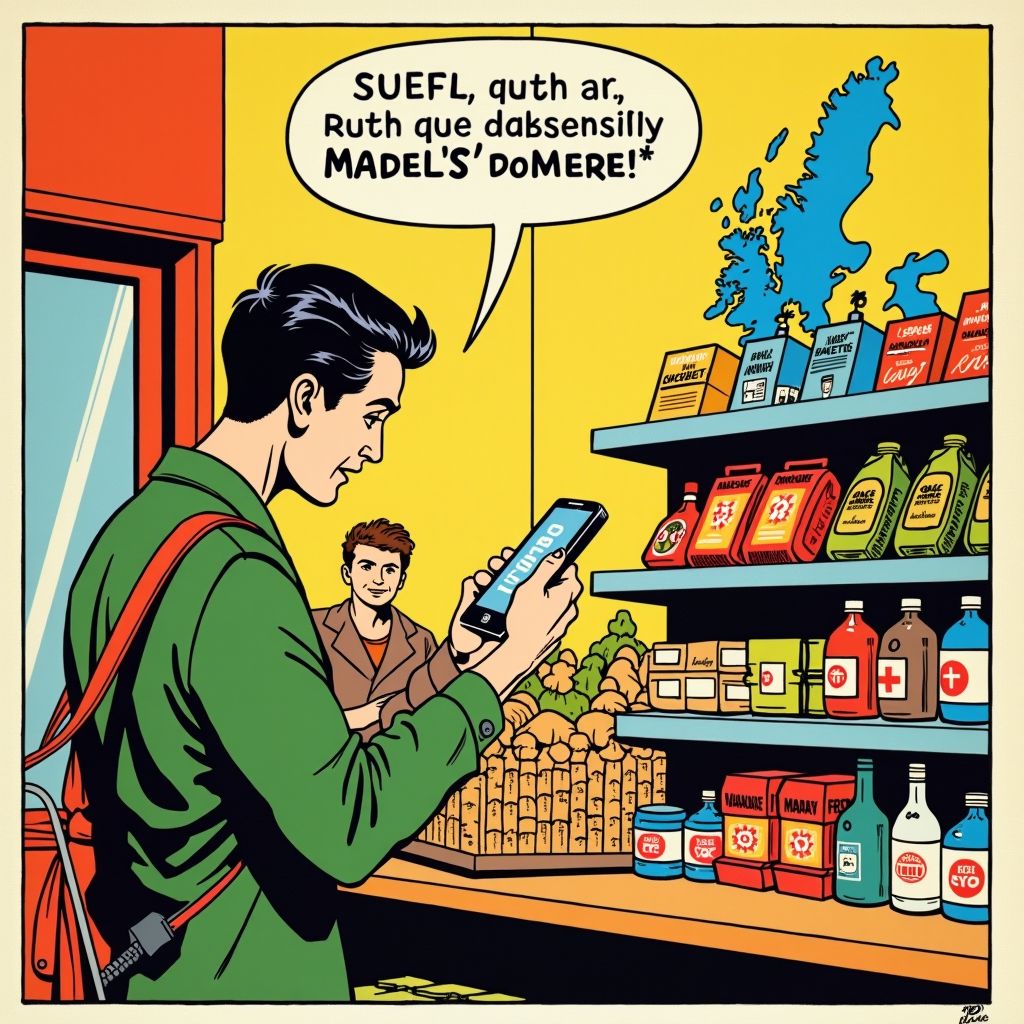
a surge in downloads of boycott apps in denmark reflects growing public sentiment against u.s. influence following renewed american interest in greenland. the ‘made o’meter’ app, which uses ai to detect u.s. products and suggest european alternatives, saw 30,000 new users in just three days during january 2026. at its peak, the app recorded 40,000 product scans in a single day. although american items make up only 1–3% of groceries in denmark, the symbolic act of scanning and rejecting u.s. goods resonates deeply. developers note a shift from curiosity to active civic engagement. users report feeling empowered, despite doubts about the actual economic impact. the apps are now active across europe and even in venezuela, signaling broader discontent.
surge in app usage tied to geopolitical tensions
In Denmark, the ‘Made O’Meter’ app saw approximately 30,000 new downloads within three days during heightened tensions over Greenland in January 2026 [1]. At its peak on January 23, the app recorded 40,000 product scans in a single day [2]. This marks a significant increase compared to roughly 500 daily scans observed during summer 2025 [3]. The surge coincided with former U.S. President Donald Trump’s renewed push to acquire Greenland, sparking national frustration [4]. Users turned to the app as a tool for civic action amidst strained bilateral relations [5].
expanding reach beyond danish borders
While initially focused on Danish consumers, ‘Made O’Meter’ now boasts over 20,000 users in Denmark alone, with additional adoption in Germany, Spain, Italy, and Venezuela [1]. Another app, ‘NonUSA’, surpassed 100,000 total downloads by early February 2026 [6]. Of those, 46,000 users are based in Denmark and 10,000 in Germany [7]. The widespread uptake indicates that resentment toward U.S. policy extends beyond Denmark’s borders [8]. Both applications are available through Apple’s App Store and Google’s Play Store, facilitating international access [9].
limited shelf presence amplifies symbolic value
Despite rising app activity, U.S. products occupy only 1–3% of Danish grocery shelves, including items like nuts, wine, and candy [10]. Experts point out that the economic impact of avoiding such goods is minimal [11]. However, the act of scanning serves as a symbolic rejection of U.S. foreign policy [12]. According to Christina Gravert, associate professor of economics at the University of Copenhagen, targeting consumer behavior could still influence corporate sourcing decisions [13]. She notes larger effects may emerge if major retailers respond to customer preferences [14].
technology bridges gap between intent and action
The ‘Made O’Meter’ app leverages artificial intelligence to analyze product labels and determine country of origin with claimed 95% accuracy [1]. It further suggests European alternatives to assist informed purchasing [15]. Creator Ian Rosenfeldt stated the idea emerged after joining a Danish boycott-focused Facebook group in 2025 [16]. He explained the motivation was practical: ‘How do we actually do this in practical terms?’ [17]. By simplifying identification, the app transforms abstract dissatisfaction into tangible daily choices [18].
users express mixed feelings on effectiveness
Some Danes describe using the apps as empowering, giving them a sense of regained agency [19]. Jonas Pipper, creator of ‘NonUSA’, noted users reported relief from feeling helpless [20]. Retired navy officer Morten Nielsen admitted most boycott efforts rely on recognizing brand names rather than thorough investigation [21]. Others, like retiree Charlotte Fuglsang, oppose the approach altogether, citing her affection for travel in the United States [22]. Still, the persistent usage—around 5,000 scans daily as of early February 2026—suggests enduring engagement [23].
diplomatic developments shape consumer response
The spike in app usage followed threats by Donald Trump to impose tariffs on Denmark and seven other European Union members over opposition to U.S. ambitions regarding Greenland [24]. Those threats were withdrawn after a ‘framework’ agreement brokered by NATO Secretary-General Mark Rutte on January 23, 2026 [25]. Concurrently, technical discussions began between the U.S., Denmark, and Greenland on Arctic security matters [26]. Despite negotiations, both Danish and Greenlandic officials maintain that sovereignty is non-negotiable [27]. Public sentiment remains sensitive to perceived external pressures [28].
Bronnen
- apnews.com
- abcnews.go.com
- www.abc.net.au
- www.hurriyetdailynews.com
- www.youtube.com
- www.abc.net.au
- www.hurriyetdailynews.com
- apnews.com
- abcnews.go.com
- apnews.com
- www.abc.net.au
- www.hurriyetdailynews.com
- apnews.com
- www.abc.net.au
- www.youtube.com
- apnews.com
- www.abc.net.au
- www.hurriyetdailynews.com
- apnews.com
- www.abc.net.au
- apnews.com
- www.abc.net.au
- abcnews.go.com
- www.hurriyetdailynews.com
- apnews.com
- www.abc.net.au
- www.hurriyetdailynews.com
- abcnews.go.com