Xi's bezoek aan Noord-Korea: machtsspel in Pyongyang
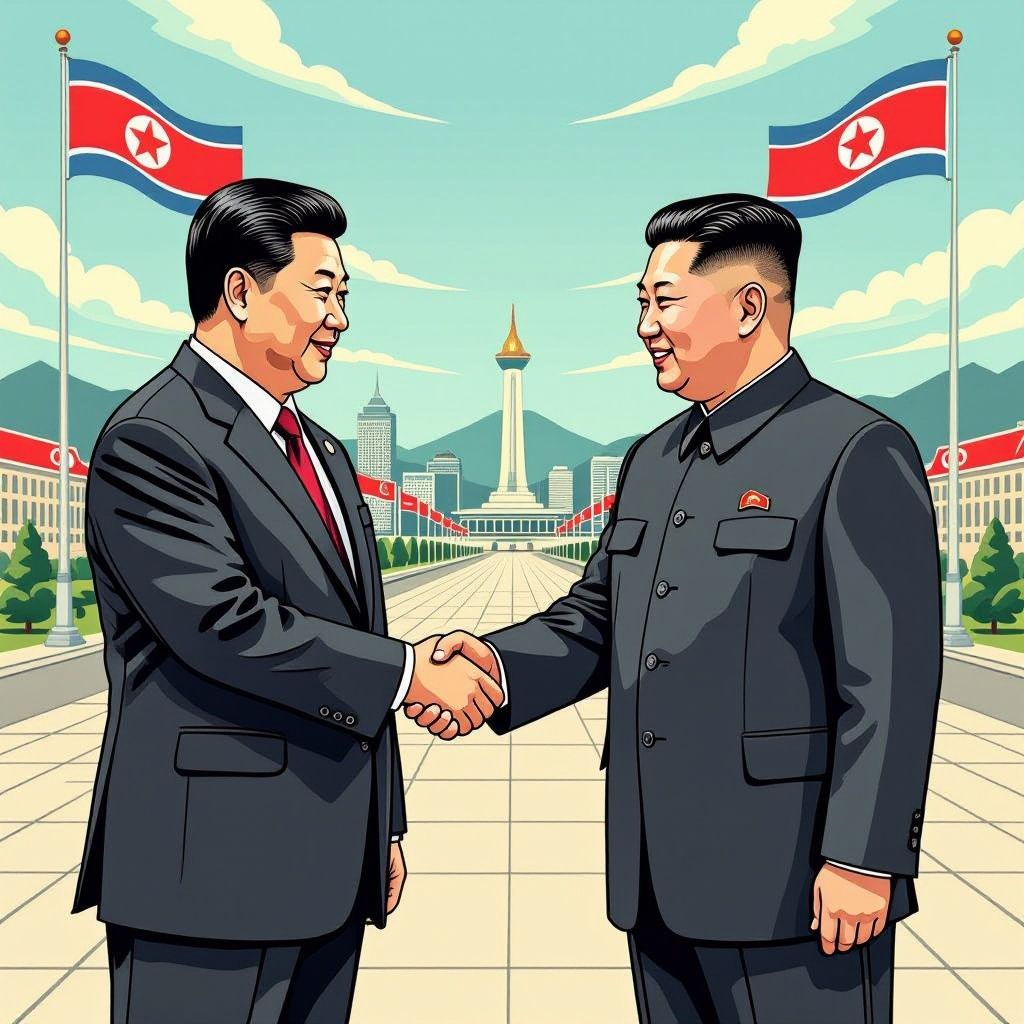
Pyongyang, maandag, 8 juni 2026.
Chinese president Xi Jinping arriveerde maandag in Pyongyang voor een tweedaags staatsbezoek. Het is zijn eerste reis naar Noord-Korea sinds 2019. De relatie tussen China en Noord-Korea wordt formeel ‘onoverwinnelijk’ genoemd. Toch is er spanning onder de oppervlakte. Noord-Korea werkt steeds nauwer samen met Rusland. Dat irriteert China. Expert Casper van der Veen wijst op een cruciale afhankelijkheid: 80 tot 90 procent van Noord-Korea’s goederen komt uit China. Economische samenwerking en regionale veiligheid staan centraal. Ook de nucleaire kwestie komt aan bod. De ontmoeting met Kim Jong-un moet de strategische betrekkingen versterken. China probeert invloed te behouden. De geopolitieke dynamiek in Azië hangt mee aan dit bezoek. Internationale diplomatie rond Noord-Korea staat op losse schroeven.
china’s strategic calculus
China views North Korea as a crucial buffer zone against US forces stationed in South Korea [nu]. Approximately 28,000 American troops are based in South Korea, creating a direct security concern for Beijing [nu]. While publicly affirming an “unbreakable” alliance, China privately seeks greater control over Pyongyang’s actions [VRT]. The recent deepening of military and economic ties between North Korea and Russia has caused unease in Beijing [SVT]. Analysts note China feels irritated by North Korea’s independent diplomacy with Moscow and Washington [VRT][nu]. Maintaining stability on its border remains paramount for Chinese leadership.
economic dependence and leverage
Beijing holds significant economic sway over Pyongyang, supplying an estimated 80 to 90 percent of North Korea’s essential goods [VRT][nu]. This dependence forms the bedrock of China’s influence strategy [VRT]. However, experts indicate China deliberately limits transformative investments to prevent North Korea from achieving full economic self-sufficiency [BBC][Yahoo]. Scholar Lee Cheng-hyun describes this approach as providing just enough support to avert collapse while withholding resources for genuine development [BBC][Yahoo]. Former Swedish Foreign Minister Carl Bildt observes this dynamic gives China leverage, though its effectiveness fluctuates based on Pyongyang’s other international connections [SVT].
the shifting nuclear equation
North Korea’s nuclear weapons program presents a persistent dilemma for China [BBC]. While Beijing opposes further proliferation, it prioritizes regional stability over demanding immediate disarmament [BBC]. North Korean leader Kim Jong-un recently reiterated his country’s nuclear status is irreversible [VRT]. This stance complicates China’s position internationally, particularly regarding United Nations sanctions which Beijing helped establish but often applies loosely [BBC]. The growing military cooperation between Pyongyang and Moscow, including reports of North Korean troop deployments and arms transfers to aid Russia’s war effort, further challenges Beijing’s desire for predictability [BBC][HK01].
diplomatic maneuvering and symbolism
Xi Jinping’s visit, his first outside China in months, underscores the importance placed on managing the relationship with Kim Jong-un [nu]. The timing follows high-profile visits to Beijing by both Russian President Vladimir Putin and former US President Donald Trump in May 2026 [VRT][nu]. By traveling to Pyongyang personally, Xi aims to reaffirm China’s primacy as North Korea’s main ally and counterbalance perceived gains by Moscow [SVT][HK01]. The trip coincides symbolically with the 65th anniversary of the Sino-North Korean Mutual Aid and Cooperation Friendship Treaty, highlighting the formal military alliance [HK01]. Analysts see this as an attempt to recalibrate influence through personal diplomacy.
regional implications and future outlook
The outcome of the Xi-Kim talks could significantly impact security dynamics across Northeast Asia [SVT]. China seeks enhanced communication and coordination with North Korea on regional matters, advocating for a global order centered on the United Nations [VRT]. Simultaneously, North Korea’s own strategic moves, such as formally abandoning reunification goals in its new constitution, alter the fundamental landscape of the peninsula [HK01]. These changes potentially weaken the rationale for continued strong US alliances with South Korea and Japan, indirectly serving broader Chinese interests [HK01]. The extent to which Beijing can translate its economic clout into concrete policy concessions from Pyongyang remains uncertain [alert! ‘outcome of negotiations undisclosed’].