bnp wint historische verkiezingen in bangladesh na val van sheikh hasina
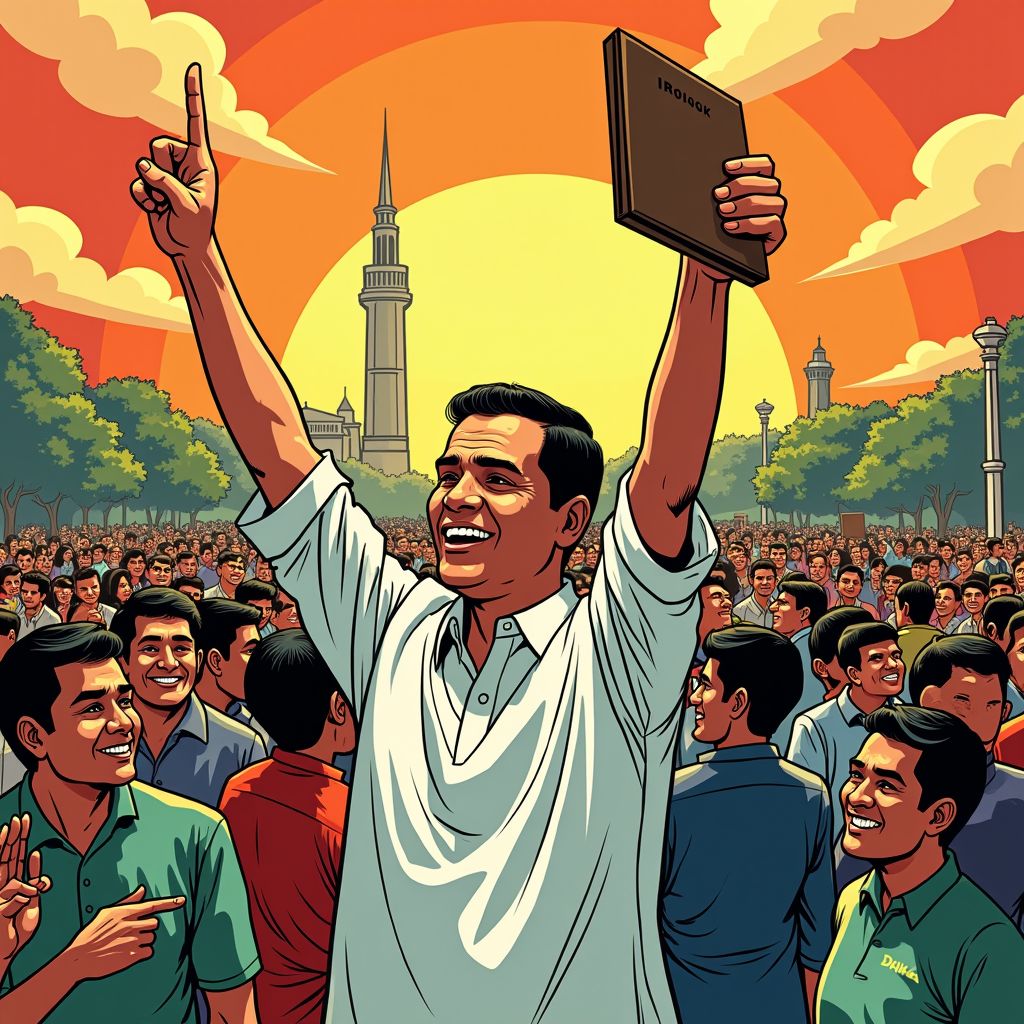
Dhaka, vrijdag, 13 februari 2026.
Bangladesh heeft een historische keerpunt bereikt met de overwinning van de Bangladesh Nationalist Party (BNP) in de eerste parlementsverkiezingen sinds de val van premier Sheikh Hasina. Haar vertrek in 2025 volgde op massale studentenprotesten die ruim duizend levens eisen. Hasina werd later bij verstek ter dood veroordeeld en haar partij, de Awami League, werd uitgesloten van de stembusgang. De BNP, geleid door Tarique Rahman, keert terug naar de macht na zeventien jaar ballingschap. Ruim 127 miljoen kiezers kozen ook over een grondwettelijk hervormingspakket, de July Charter. De uitslag brengt hoop voor democratieherstel, maar ook zorgen over toekomstige burgerlijke vrijheden en regionale stabiliteit.
historic victory for bnp in post-uprising bangladesh
In Dhaka, Bangladesh, the Bangladesh Nationalist Party (BNP) has claimed victory in the country’s first parliamentary elections since the 2024 student uprising that ended Sheikh Hasina’s 15-year rule [1]. The election, held on February 12, 2026, marks a pivotal moment in the nation’s political trajectory after 18 months without an elected government [2]. With approximately 127 million eligible voters, the poll also included a concurrent referendum on the July Charter, aimed at introducing structural reforms such as term limits and a bicameral legislature [3]. The BNP’s success signals a dramatic reversal of political fortunes after years of marginalization under Hasina’s administration.
transition of power after hasina’s downfall
Former Prime Minister Sheikh Hasina fled to India in August 2024 following widespread unrest triggered by youth-led protests against discriminatory job quotas, which escalated into a broader anti-government movement [4]. An estimated 1,400 demonstrators lost their lives during the crackdown [5]. In November 2025, Hasina was sentenced to death in absentia for crimes against humanity related to the suppression of the protests [1]. Subsequently, her party, the Awami League, was barred from participating in the 2026 elections by the Election Commission [6]. This exclusion reshaped the political landscape, paving the way for the BNP’s resurgence after years of repression and arrests of its leadership.
tarique rahman returns from exile to lead new government
Tarique Rahman, son of former Prime Minister Khaleda Zia and newly appointed chairman of the BNP, returned from 17 years of self-imposed exile in London to lead his party’s campaign [7]. Rahman formally assumed leadership in December 2025 following his mother’s passing [8]. He emerged as the frontrunner for the premiership after securing 170,544 votes in Bogura-6, significantly ahead of his closest rival [9]. Despite leading celebrations, Rahman prohibited victory rallies, calling instead for special prayers after Friday congregational prayers, emphasizing restraint and unity during the transition period [10]. His platform focused on restoring law and order, combating corruption, and improving citizen security.
election dynamics and voter participation
Official data recorded a 60.69% voter turnout across 299 constituencies, with one seat annulled due to the pre-election death of a candidate [11]. Around 47% of eligible voters had cast their ballots by early afternoon, reflecting sustained engagement throughout election day [12]. To maintain order, authorities deployed over 150,000 police officers and 100,000 military personnel nationwide, resulting in a mostly peaceful environment despite isolated incidents of violence [13]. Bomb explosions occurred in Munshiganj and Gopalganj, injuring three individuals, including a minor [14]. International observers, including 394 monitors from various organizations, assessed the process as generally orderly and reflective of public will [15].
competing visions: bnp versus islamist coalition
The BNP contested as the lead party in a ten-party alliance, positioning itself as a center-right nationalist alternative [16]. Their main competitors were an eleven-party coalition led by Jamaat-e-Islami, a conservative Islamist formation advocating greater religious influence in governance [17]. Although historically opposed, both groups capitalized on public discontent toward the previous regime. Jamaat-e-Islami, previously banned under Hasina, re-entered mainstream politics seeking its strongest showing since the 1971 independence [18]. Despite aggressive campaigning—some reports alleging vote-buying through cash payments and spiritual incentives—the coalition fell short of challenging the BNP’s dominance [19]. Observers noted ideological distance between the two blocs, reducing prospects for immediate cooperation.
referendum on the july charter shapes future governance
Alongside the parliamentary vote, citizens participated in a constitutional referendum centered on the July Charter, a reform package born from the 2024 uprising [20]. Proposed changes include limiting the prime minister to two consecutive five-year terms, establishing an upper legislative chamber, strengthening judicial independence, and reinstating non-partisan caretaker governments during transitions [21]. While official results remain pending, proponents argue the measures aim to prevent future authoritarian drift. Interim leader Muhammad Yunus described the day as ‘the birthday of a new Bangladesh,’ celebrating the electorate’s rejection of past autocracy [22]. Critics, however, question the legitimacy of reforms enacted under transitional rule, urging cautious implementation to preserve inclusive democracy.
public sentiment and hopes for democratic renewal
Many voters expressed renewed faith in democratic processes, describing the atmosphere as festive and liberating [23]. Hasan Hoque, a retired teacher, said casting his ballot felt ‘like a festival,’ contrasting sharply with previous elections conducted under Awami League control [24]. Jainab Lutfun Naher voiced aspirations for prosperity and expanded civil liberties, echoing sentiments shared across urban and rural centers [25]. Young voters, comprising roughly 40 million citizens aged 18–29, played a decisive role in shaping the outcome [26]. Civil society representatives warn that sustaining momentum requires safeguarding minority rights, press freedom, and institutional integrity—especially concerning the treatment of Hindus and other vulnerable communities in light of rising Islamist rhetoric [27].
regional implications and diplomatic outlook
The political transformation in Bangladesh carries significant implications for South Asian geopolitics, particularly regarding relations with India [28]. Historically tense under Hasina due to border disputes and accusations of interference, the BNP has pledged to reassess bilateral ties while maintaining strategic autonomy [29]. India closely monitored the polls, given its substantial interests in regional stability and counterterrorism coordination. Neighboring countries and Western allies have signaled conditional support, contingent upon adherence to human rights norms and transparent governance [30]. As the new administration prepares to assume office, international attention focuses on policy continuity in climate resilience, garment exports, and foreign investment frameworks—all vital to Bangladesh’s $460 billion economy [GPT].
Bronnen
- nos.nl
- www.trendr.nl
- www.aljazeera.com
- www.youtube.com
- www.aljazeera.com
- www.ndtv.com
- www.aljazeera.com
- www.youtube.com