Europese samenwerking tegen explosieve dreiging
Rotterdam, donderdag, 5 maart 2026.
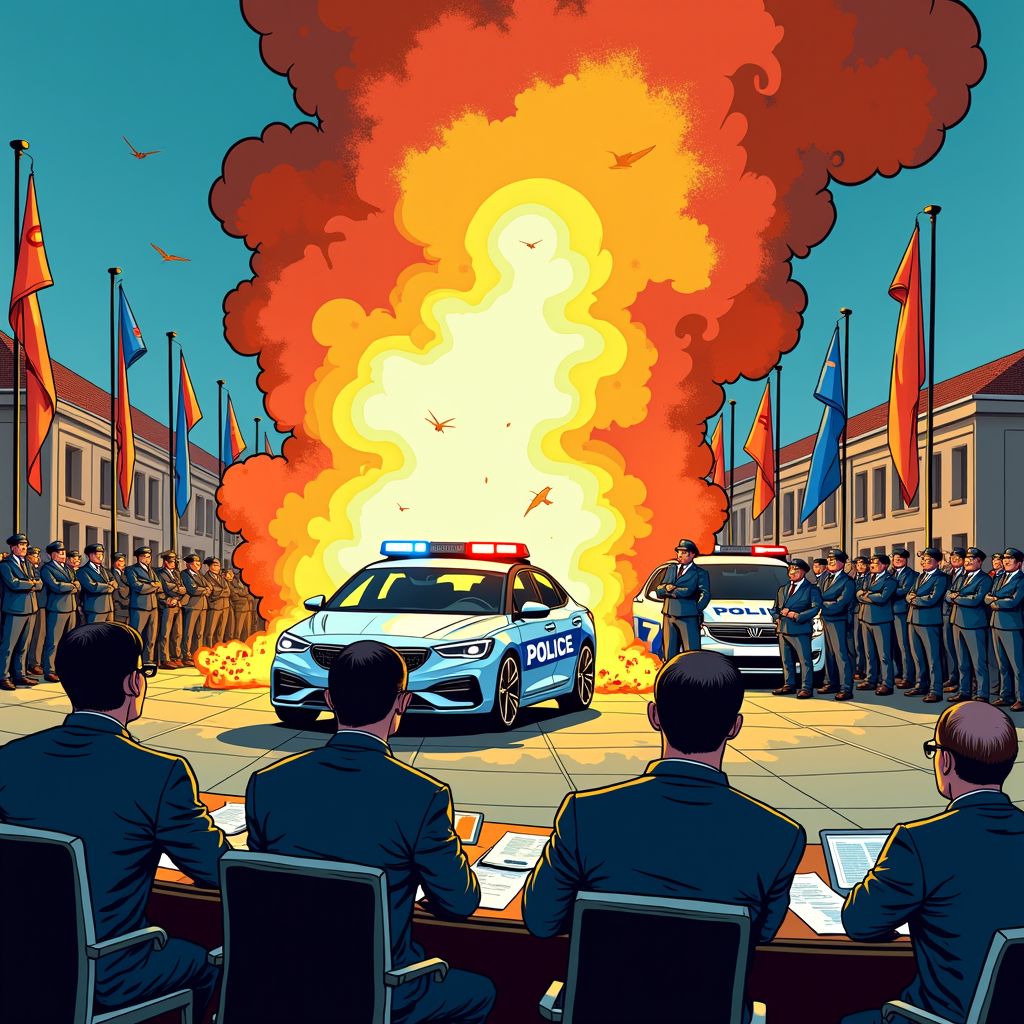
Tijdens een internationale politieconferentie in Rotterdam is een hardere aanpak van illegaal zwaar vuurwerk afgesproken. Europese landen starten gezamenlijke opsporingsonderzoeken naar de handel, het transport en de opslag van dit gevaarlijke materiaal. De druk neemt toe na een grootschalige demonstratie waarbij twintig cobra’s een hele auto deden verdwijnen. Het experiment liet de brute kracht van illegaal vuurwerk zien. Nederland lanceert nu een oproep tot een Europees verbod. Criminele netwerken opereren al jaren grensoverschrijdend. De explosies vinden steeds vaker plaats in woonwijken. Burgemeesters en politieleiding eisen actie. De eerste gezamenlijke onderzoeken beginnen in juni 2026.
rotterdam hosts european crackdown on illegal fireworks trade
The Netherlands hosted a two-day international police conference on combating illegal heavy fireworks, bringing together law enforcement delegates from Belgium, France, Germany, Spain, Sweden, Poland, Slovenia, Austria, Bulgaria, Europol, the European Commission, and members of the European Parliament [1]. Held in Rotterdam on March 3–4, 2026, the event underscored urgent cross-border cooperation against the trafficking and misuse of powerful explosives like cobra firecrackers [1]. National coordinator for fireworks Ko Minderhoud stressed that policy discussions must now transition into joint investigations [1].
devastating power demonstrated in brabant military zone
A controlled demonstration took place at the Kamp de Kiek defense site in Riel, North Brabant, where twenty cobra firecrackers were detonated inside the trunk of an Audi A6 [2]. The explosion completely destroyed the vehicle, leaving almost nothing intact [2]. Another test involved seven cobras placed in a backpack, which obliterated a mannequin [2]. These visuals were shown to foreign police representatives to illustrate the destructive potential of illegally trafficked materials entering residential areas across Europe [2].
rising toll fuels push for coordinated action
In 2025, the Netherlands recorded 1,525 incidents involving attacks or attempted attacks using heavy fireworks [1]. This surge correlates with increasing storage near borders, particularly in German facilities exploited by Dutch criminal networks [2]. According to Ko Minderhoud, countries previously unaffected are now actively seeking collaboration due to spreading threats [1]. Carola Schouten, mayor of Rotterdam and chair of Offensief Tegen Explosies (OTE), emphasized that blasts in neighborhoods severely disrupt public safety and residents’ well-being [1].
from dialogue to investigation
European authorities agreed to shift from discussion-based coordination to active joint operations targeting producers, distributors, online sellers, and end users [1]. The first progress review meeting is scheduled for June 2026, followed by a second assessment in October 2026 [1]. The initiative, led by Dutch police and OTE, calls for stricter regulation under the EU Pyro Directive and advocates for a total ban on Category F4 fireworks—commonly known as ‘heavy fireworks’ [1]. Harmonization of national laws is seen as essential to dismantling transnational supply chains [1].