den haag raises the bar with twin towers set to become netherlands' highest
Den Haag, zaterdag, 4 april 2026.
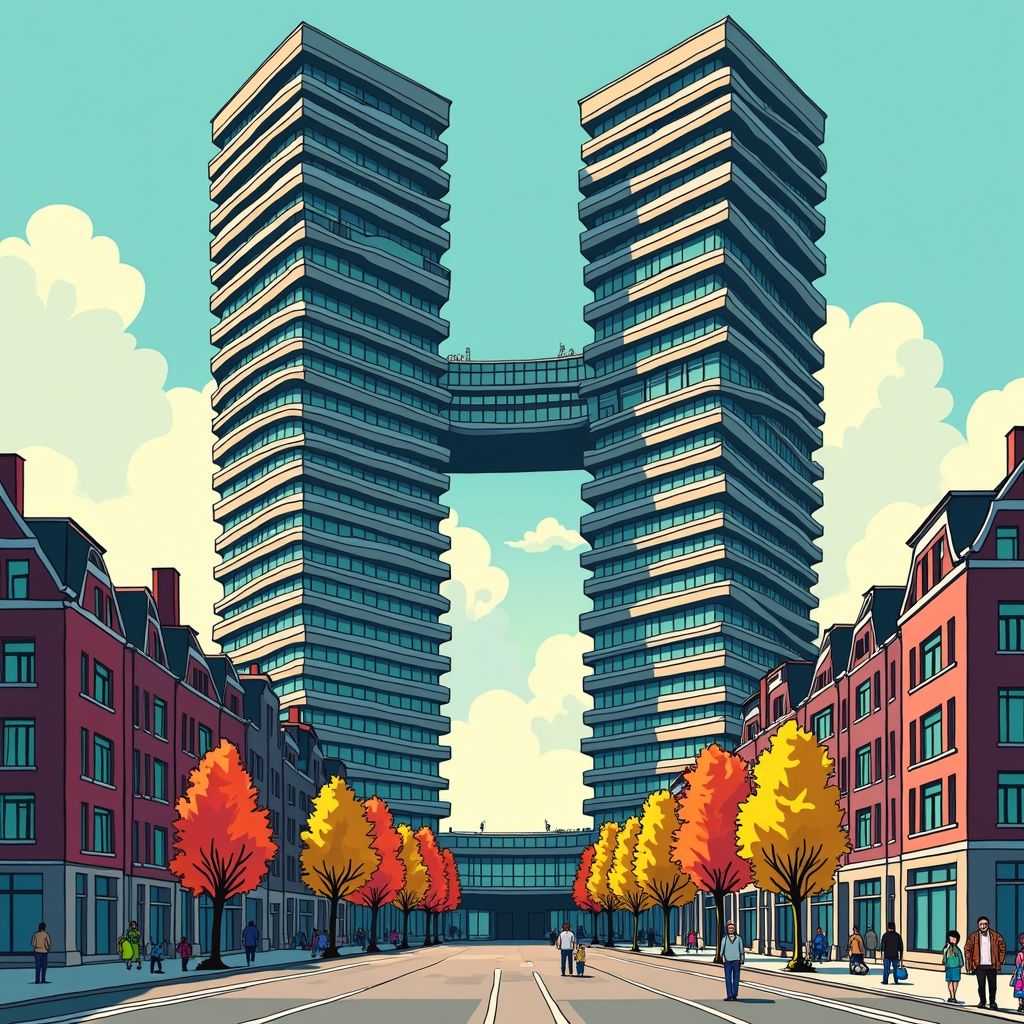
two residential skyscrapers, each rising 230 meters, are planned near den haag central station. these structures will surpass rotterdam’s zalmhaventoren to become the tallest buildings in the netherlands. designed by powerhouse company, the towers aim to ease the city’s severe housing shortage by delivering over 1,000 homes. connected by skybridges, they form a vertical neighborhood with integrated living, working, and communal spaces. despite criticism over density and loss of green views, architect nanne de ru emphasizes practicality—linking the design to urgent housing needs. historic facades along oranjebuitensingel will remain, blending old and new. an environmental permit is expected to be filed this summer, marking a pivotal step in shaping den haag’s evolving skyline.
den haag plans twin 230-meter towers near central station
Two residential skyscrapers, each standing 230 meters tall, are planned near Den Haag Centraal station along the Bezuidenhoutseweg [1]. Once completed, these towers will become the tallest buildings in the Netherlands, surpassing the 215-meter Zalmhaventoren in Rotterdam by 15 meters [2]. The project replaces outdated office buildings from the 1970s and 1980s, aiming to address the city’s acute housing shortage [1]. Developed by Patrizia, Staedion, RED Company, and designed by Powerhouse Company, the site lies between Rijnstraat, Bezuidenhoutseweg, and Oranjebuitensingel [1].
over 1,000 homes to tackle housing crisis
The development will deliver more than 1,000 residences, combining social, mid-rent, and free-market housing units [1]. While earlier proposals included 1,800 homes under the name “Bellevuetorens,” the current iteration focuses on feasibility and integration [2]. Architect Nanne de Ru emphasized urgency, stating, “De woningnood is zo groot, het gaat over weinig anders” [2]. The design prioritizes volume to meet demand, with shadow effects primarily impacting the Malieveld rather than surrounding neighborhoods [1][2].
vertical neighborhood linked by skybridges
The twin towers will connect via skybridges, enabling residents seamless access to shared facilities and communal areas [1]. This creates what developers call a “verticale buurt”—a vertical neighborhood integrating living, workspaces, and services [1]. Ground-level planning includes mixed-use functions such as retail and public amenities, intended to activate street life [1]. Despite concerns over scale, architects argue the building’s base—or “plinth”—will maintain human-scale interaction and integrate greenery [1].
preserving history amid modern growth
Historical façades along Oranjebuitensingel will remain intact within the new design, preserving architectural heritage amidst redevelopment [1]. This approach balances progress with continuity, acknowledging local identity [1]. Previous attempts to limit tower height were reversed after initial restrictions sparked debate [2]. Now, with municipal support secured, the project moves toward formal application processes [2]. Public consultation continues during upcoming stages [1].
criticism grows over density and character
Local opposition cites excessive density, insufficient infrastructure, and potential loss of green visibility [1]. Critics label the proposal “megalomaan” and incompatible with Den Haag’s traditional urban fabric [2]. Some worry future skylines may obscure landmarks like the “Haagse tieten,” colloquial names for the existing 104-meter Castalia towers [3]. However, proponents stress necessity, noting that foundations capable of supporting 180-meter structures can safely bear 230-meter loads [2]. Urban expansion upward reflects broader national trends driven by land scarcity [GPT].
permit process begins this summer
An environmental permit application is scheduled for summer 2026, marking a critical milestone in realization [1]. Final designs continue to evolve through dialogue with city officials and stakeholders [1]. Concurrent discussions involve creating a distinctive upper structure—a “hoed” or hat—to comply with Den Haag’s policy requiring iconic rooftop features since 2018 [2]. Construction timelines depend on approval speed and regulatory compliance [1][2]. No demolition date has been confirmed for the existing Bellevue office complex [2].
broader shift toward circular construction practices
While not directly related to this project, the Dutch construction sector increasingly adopts circular principles exemplified by firms like Cepezed [4]. Their reuse of materials from demolished buildings—such as the former Zuiderstrandtheater—highlights sustainable alternatives to traditional demolition [4]. By designing structures for disassembly, companies reduce waste and carbon emissions [4]. Experts suggest pairing CO₂ taxes on new materials with labor tax reductions could accelerate adoption across large developments like those in Den Haag [4].