een 2000 jaar oude steen ontraadt: ai helpt bij ontdekking van nieuw romeins bordspel
Heerleaf, donderdag, 12 februari 2026.
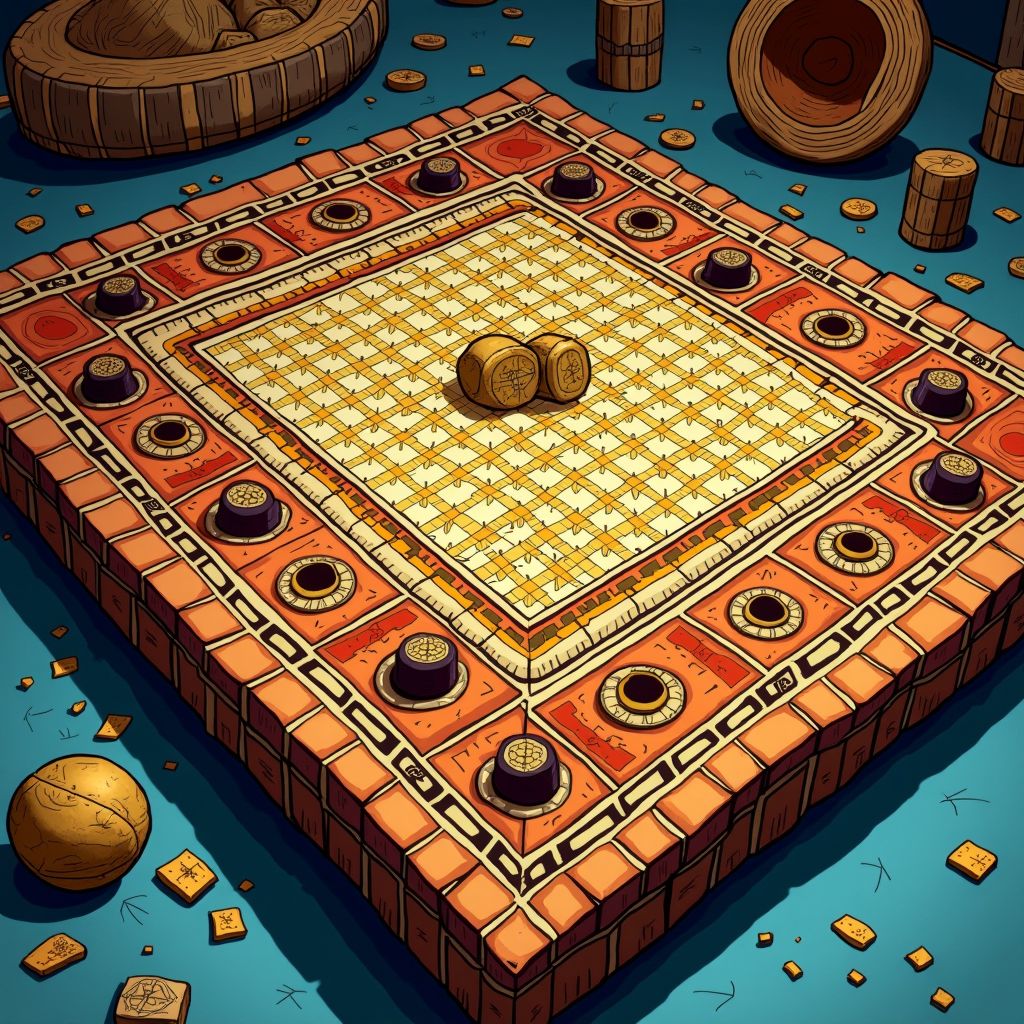
In het Romeins Museum in Heerlen is een oude steen jarenlang voorbijgegaan als decoratief object. Nu blijkt dat het een strategisch bordspel uit de Romeinse tijd is. Kunstmatige intelligentie heeft de inscripties op de steen geanalyseerd en niet alleen het spel herkend, maar ook mogelijke spelregels achterhaald. Uit 3D-scans bleek een duidelijk slijtagepatroon langs de lijnen, passend bij het verschuiven van pionnen. De AI-tool Ludii vergeleek dit patroon met honderden historische spelletjes en vond een match. Het spel, mogelijk gespeeld met stenen van glas of bot, was tot nu toe onbekend in Gallia Belgica. De vondst opent de deur naar herbekijken van vele andere onduidelijke artefacten.
the mystery stone from heerlen
For decades, a rectangular limestone slab in the Roman Museum in Heerlen puzzled researchers. Found near the ancient Villa Coriovallum, the stone bore four diagonal lines and one straight line carved into its surface [1]. Initially considered decorative, new analysis suggests it served a very different purpose [2]. Detailed 3D scans revealed wear patterns along the incisions, indicating repeated movement across them [3]. These traces measure approximately 0.1 millimeters deep in places, suggesting sustained mechanical action rather than random damage [4]. Such evidence aligns more closely with game play than ritualistic or architectural function [1][3].
ai unlocks ancient gameplay
Researchers from Maastricht University deployed an artificial intelligence system called Ludii to decode the stone’s purpose [1]. The AI had been trained on rule sets from around 100 historical games dating back to antiquity [5]. By simulating thousands of potential rule combinations, Ludii identified several plausible gameplay models [6]. One variation stood out due to its strong alignment with the physical wear marks observed on the stone [7]. According to this reconstruction, players would take turns moving pieces—likely made of glass, bone, or pottery—to block each other’s movements [1][8]. Victory went to the player who successfully immobilized their opponent’s tokens [1].
cautious validation by experts
While the findings point strongly toward a strategic board game, lead researcher Dennis Soemers urges caution in interpretation [1]. “If you show Ludii a pattern like those on the stone, it will always find matching rules,” he explains, noting that correlation does not guarantee historical accuracy [1][5]. Still, the match between simulated moves and actual abrasions supports the theory [7]. Archaeologist Walter Crist from Leiden University notes the location and nature of the wear correspond precisely to where one would slide playing pieces [3][8]. This convergence of digital modeling and physical evidence strengthens the hypothesis [6][9].
a newly recognized roman pastime
The reconstructed game, informally dubbed ludus coriovalli, appears previously undocumented in records from Gallia Belgica [9]. Its mechanics bear resemblance to later medieval blocking games but predate known versions by centuries [2]. The game may have involved nine distinct configurations playable on the same board, according to AI simulations [5]. Pieces were likely small and portable, allowing soldiers or merchants to carry them during travel [8]. This insight sheds light on social life among Romans stationed far from the empire’s center [9]. The study has been published in the peer-reviewed journal Antiquity, lending academic credibility to the claim [1][10].
unlocking dormant artifacts with ai
The success in decoding the Heerlen stone has broader implications for archaeology [5]. Conservator Karen Jeneson highlights that the museum holds roughly 50,000 unidentified objects in storage [5]. Many lack contextual clues, making traditional analysis difficult [10]. With tools like Ludii, researchers can now test functional hypotheses against large databases of ancient activities [7]. “It’s like finding the key to a hidden treasure chest,” Jeneson remarked [5]. Future projects aim to apply similar methods to enigmatic finds elsewhere in Europe [9]. A planned collaboration will examine an Egyptian gaming table dated between 3900 and 3700 BCE using 3D simulation techniques [9].
Bronnen
- www.nu.nl
- nu.cw
- stvs.sr
- www.l1nieuws.nl
- www.maastrichtuniversity.nl
- www.l1nieuws.nl
- erfgoedstem.nl
- www.vrt.be