massaal pesticidenmisbruik in de glastuinbouw ontdekt
Westland, woensdag, 18 februari 2026.
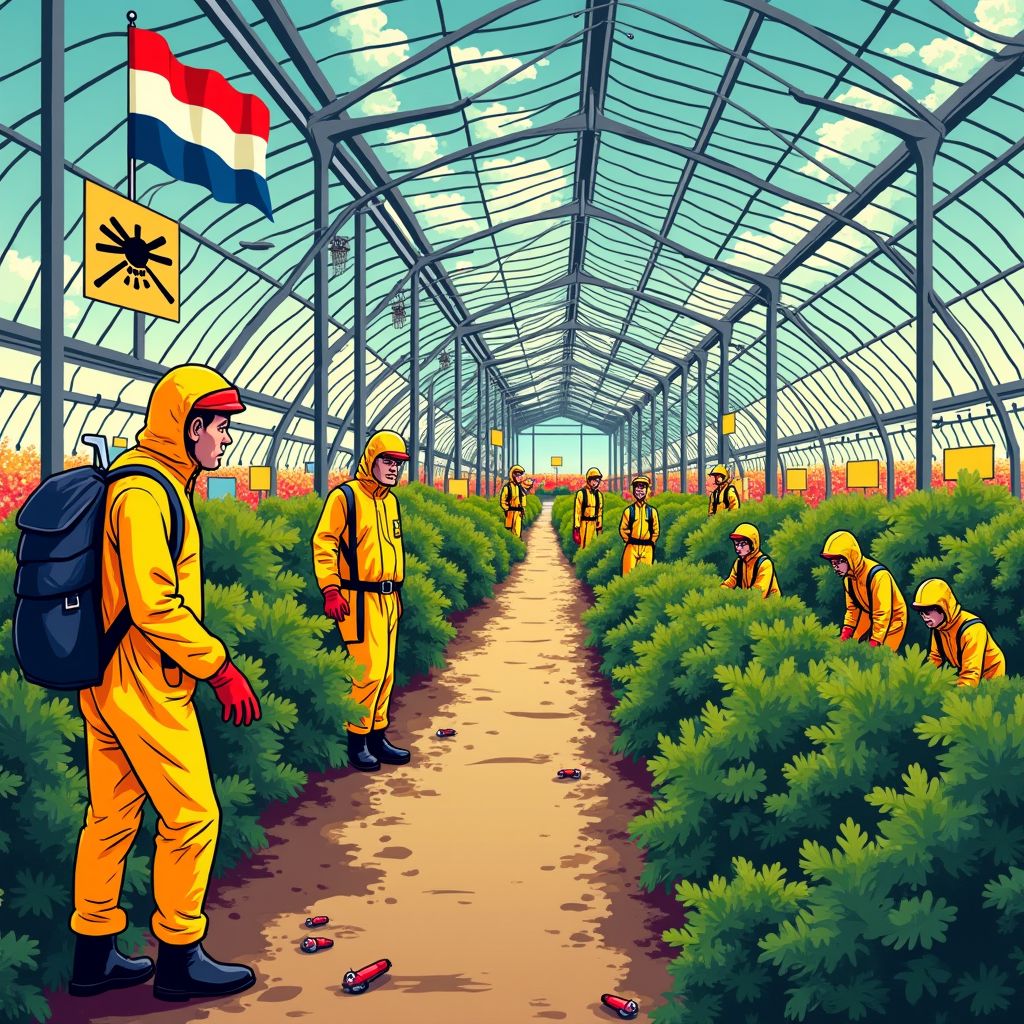
Bijna tweederde van de snijbloementelers in Nederland gebruikt pesticiden verkeerd. Uit een NVWA-controle blijkt dat 61 procent van de bedrijven in overtreding is. Zeven van hen zetten expliciet verboden middelen in, zoals chlorpyrifos en thiamethoxam. Wetenschappers waarschuwen dat deze stoffen neurologische schade en kanker kunnen veroorzaken. Het RIVM bevestigt dat langdurige blootstelling aan deze middelen ernstige gezondheidsrisico’s met zich meebrengt. Werken in of nabij de betrokken kassen brengt dus extra risico’s met zich mee. De meeste gevallen werden gemeten in Westland, het hart van de glastuinbouwsector. Kamerleden noemen de situatie onacceptabel. Er groeit druk op minister Wiersma om snel ingrijpende maatregelen te nemen.
Widespread pesticide violations uncovered in greenhouse horticulture
Recent inspections by the Netherlands Food and Consumer Product Safety Authority (NVWA) reveal systemic breaches among cut flower growers. A total of 71 companies were inspected across two years from February 2024 to February 2026 [1]. Shockingly, 61 percent—equivalent to 43 enterprises—were found violating pesticide regulations [1][2]. Offenses included improper application techniques, administrative errors, and the use of unapproved equipment. The geographic concentration of these infractions centers on Westland, the nation’s hub for glasshouse cultivation, indicating structural challenges in compliance enforcement [1][2].
Use of prohibited substances raises alarm
Among the inspected farms, seven were caught using pesticides explicitly banned in the European Union [1][2]. Detected chemicals include azinphos-ethyl, chlorpyrifos, spirodiclofen, clothianidin, thiamethoxam, and metoxuron [1][2]. These substances carry known ecological and human health hazards. Chlorpyrifos and azinphos-ethyl belong to organophosphates, which impair nervous system function [2]. Neonicotinoids like thiamethoxam and clothianidin are associated with pollinator decline [2]. Their presence signals serious deviations from legal and sustainable agricultural practices in the sector [1][2].
Health implications for workers and residents
Long-term exposure to improperly applied or forbidden pesticides poses significant health threats. According to the National Institute for Public Health and the Environment (RIVM), such exposure can cause skin allergies, immune disorders, neurological damage, or various cancers [1][2]. Workers regularly handling treated plants face chronic low-level contact, potentially leading to underreported symptoms like headaches and fatigue [2]. Nearby residents may also be affected through airborne drift or contaminated runoff [1]. While occasional consumers face lower risk, occupational groups including florists and auction staff remain vulnerable even when wearing protective gear [1].
Declining compliance trends and regulatory pressure
Compliance rates among greenhouse operators have deteriorated significantly since 2019, when 60 percent followed pesticide rules compared to just 39 percent now [1]. This represents a sharp decline captured by 21 percentage points increase in non-compliance [1]. The NVWA describes the trend as ‘worrying’ and states the sector is moving in the wrong direction despite ongoing debates about chemical usage [2]. With only 25 inspectors responsible for monitoring, critics argue oversight capacity is insufficient [2]. Opposition lawmakers label the situation ‘unacceptable,’ urging Minister Wiersma to strengthen penalties and inspection frequency ahead of peak sales periods [2].
Industry responses and sustainable alternatives
Glasshouse Horticulture Netherlands acknowledges the findings with regret, noting that labeling instructions often fail to align with practical growing conditions in advanced greenhouses [1][2]. They distance themselves from illegal practices while advocating for better guidance tools. Biological pest control methods, such as predatory mites and parasitic wasps, already operate in 94 percent of Dutch greenhouses covering approximately 10,000 hectares [3]. Two-thirds of greenhouse area employs microorganisms against fungal diseases [3]. However, chemical agents are still relied upon during harvest preparation and acute disease outbreaks, highlighting transitional limitations in phasing out synthetic inputs completely [3].
Broader societal costs of agricultural chemical use
A recent analysis by Deloitte estimates that annual environmental damages caused by Dutch agriculture exceed its economic value by €5.3 billion [4]. This includes €7.9 billion in climate emissions and €7.2 billion in nitrogen pollution [4]. Pesticide use contributes directly to biodiversity loss valued at €2.5 billion annually [4]. Transitioning entirely to biological farming could reduce net societal harm from €5.3 billion to €1.1 billion per year, although national food self-sufficiency would decrease from supporting 2.5 times to 1.7 times the population [4]. Experts stress that responsibility extends beyond farmers to encompass consumer demand patterns and fragmented spatial planning policies across the EU [4].