How a trade war between trump and asia stalled The Hague's green makeover
Den Haag, zondag, 31 mei 2026.
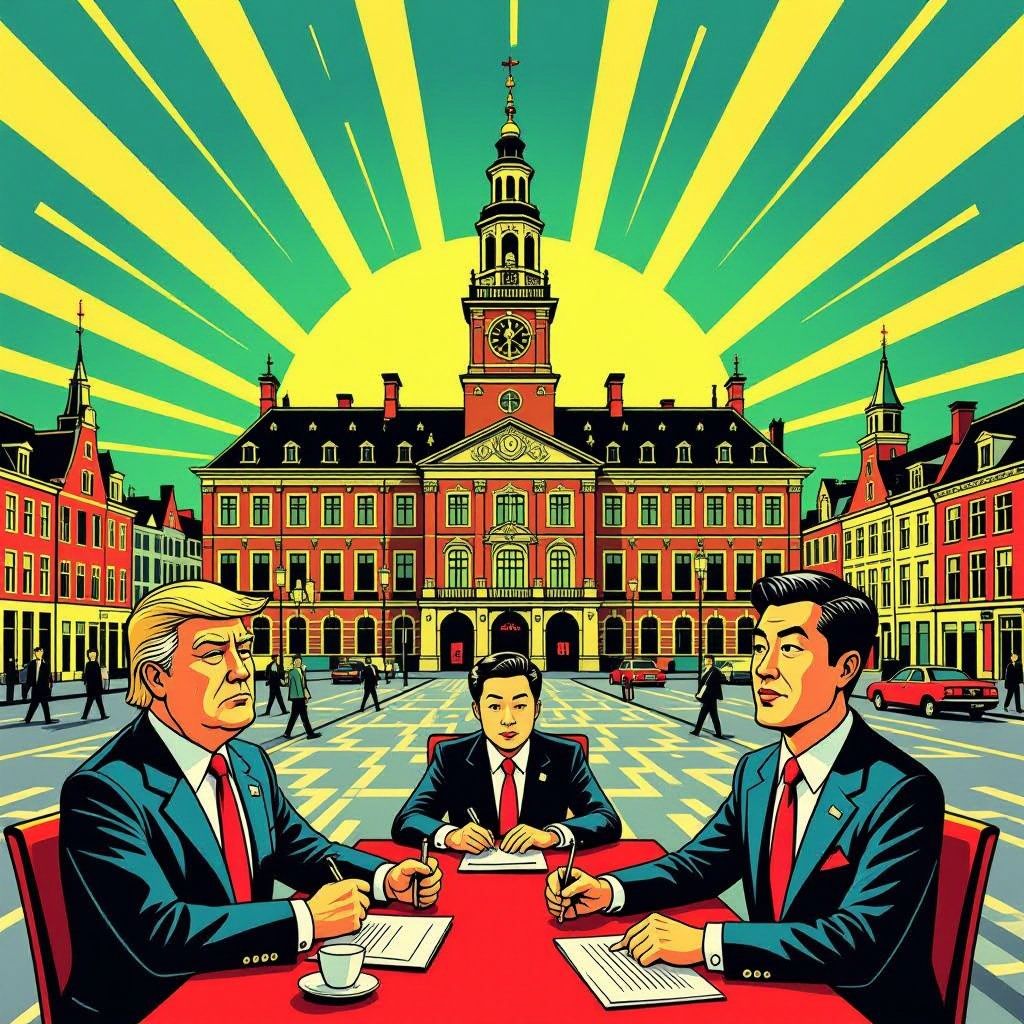
A €3.7 million sustainability upgrade for The Hague city hall has been delayed by nearly a year. The cause lies far beyond Dutch borders: new US import tariffs imposed during Donald Trump’s presidency disrupted supply chains. Crucial LED lighting components, manufactured in Asia, never arrived. The delay pushes completion to late 2026, missing a target to cut 220 tons of CO2 emissions annually. Officials confirm the contract remains intact, but global politics continue to impact local climate goals. This one project alone would offset the equivalent of 170 return flights from Amsterdam to New York each year through energy savings on lighting and green roofs.
delayed climate efforts at the hague city hall
The €3.7 million sustainability upgrade for The Hague city hall has been postponed by approximately one year due to disruptions in international supply chains [1]. The project, which includes installing 14,000 LED light fixtures and implementing green roof systems, was scheduled for completion by the end of 2025 [1]. However, new US import tariffs introduced during Donald Trump’s administration have halted shipments of essential components manufactured in Asia [1]. These delays prevent the expected annual reduction of 220 tons of CO₂ emissions [1].
global trade policies affecting local environmental goals
The intelligent lighting system central to the renovation relies on components produced in Asia, despite being designed in Europe [1]. Following the announcement of steep import tariffs by former President Trump during the NATO summit in June 2025, the supplier suspended deliveries indefinitely [1]. Although the financial agreement with the contractor remains unchanged—confirmed by a municipal spokesperson—the physical implementation cannot proceed without these parts [1]. This illustrates how shifts in global trade policy directly hinder localized climate initiatives such as The Hague’s goal to become carbon neutral by 2030 [1].
environmental and economic ripple effects
Postponing the project means forgoing immediate energy savings equivalent to removing 170 roundtrip flights between Schiphol and New York from the atmosphere each year [1]. Alternatively, the missed emission cuts equal the annual footprint of roughly 65 average Dutch households [1]. While the total budget of 3.700 million remains allocated, inflationary pressures and extended planning timelines may affect future municipal spending efficiency [1]. The municipality acknowledges that reliance on globally sourced technology introduces vulnerabilities, especially amid rising geopolitical tensions influencing trade flows [1].