powell's final act: rates held as warsh looms
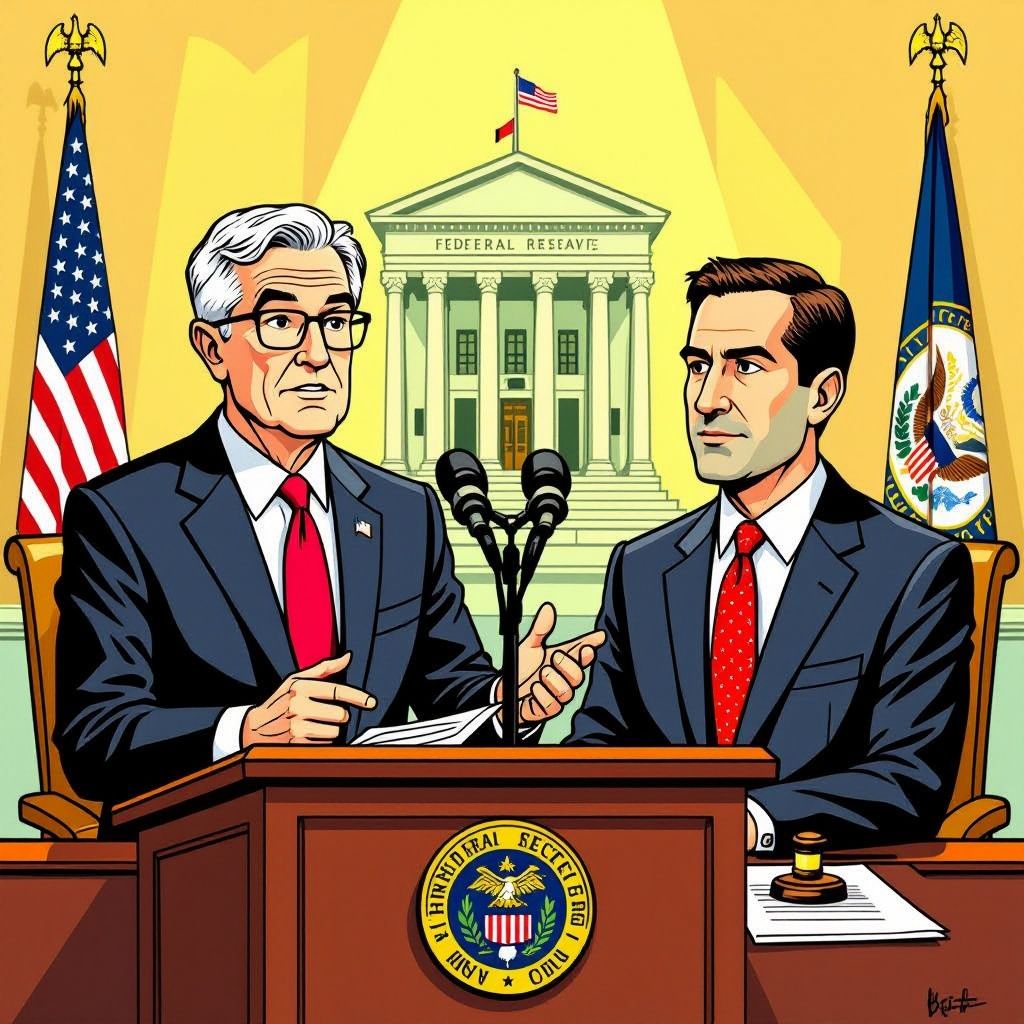
Washington D.C., woensdag, 29 april 2026.
jerome powell oversaw his likely final federal reserve meeting on wednesday, holding us interest rates steady at 3,5%-3,75%. the decision came amid sharp internal disagreement, with four governors dissenting—the most since 1992. inflation has edged up to 3,3%, driven by surging oil prices after the strait of hormuz closure. powell cited growing uncertainty from the middle east conflict. the same day, kevin warsh cleared a key senate hurdle to succeed powell, signaling a pivotal shift in u.s. monetary leadership. powell remains on the board until 2028, but insists he’ll stay quiet. the fed’s next move may rest with warsh.
united states: powell’s final meeting sets stage for warsh era
In Washington D.C., Federal Reserve Chair Jerome Powell presided over what is widely seen as his final policy meeting on April 29, 2026. The Federal Open Market Committee (FOMC) voted to maintain interest rates at 3.5%–3.75% [1]. This decision followed rising inflation pressures, with consumer prices reaching 3.3% in March—up from 2.5% earlier—and driven largely by soaring oil prices after the closure of the Strait of Hormuz [1][5]. Powell emphasized that geopolitical developments are fueling significant uncertainty [1].
internal divisions surface in fomc vote
The decision to hold rates steady drew unusual dissent, with four Federal Reserve officials opposing parts of the statement—the largest split since 1992 [1]. Governor Stephen Miran advocated for a 25 basis point rate cut, reflecting pressure from some quarters to ease borrowing costs [2]. Meanwhile, other regional Fed presidents objected to the inclusion of an ‘easing bias,’ arguing it sent premature signals amid persistent inflation [1]. This divergence highlights growing debate within the central bank about how aggressively to respond to external shocks versus managing domestic price stability [1][2].
warsh clears key senate hurdle
On the same day, Kevin Warsh advanced toward becoming the next Fed chair after the Senate Banking Committee approved his nomination by a 13–11 vote [3]. This marks a decisive breakthrough following weeks of delay caused by lingering investigations into Powell’s tenure [3]. Senator Thom Tillis, initially blocking the nomination, reversed course after receiving assurances the Justice Department had permanently closed its inquiry into Powell’s oversight of Fed headquarters’ renovations [3][4]. Warsh, nominated by President Donald Trump, is now poised for a full Senate confirmation vote [3][5].
leadership transition amid policy crossroads
Although Powell’s term as chair ends on May 15, 2026, he will remain on the Federal Reserve Board until 2028, preserving his vote on monetary policy [4]. However, he pledged to adopt a low-profile role upon Warsh’s ascension, stating, ‘There’s only ever one chair of the Federal Reserve Board’ [2]. Economists interpret this as a signal of institutional continuity during a turbulent phase [GPT]. Future rate decisions may hinge on how Warsh interprets recent inflationary pressures compared to Powell’s cautious stance [5].
markets watch tone as much as policy
Financial markets showed limited reaction to the unchanged rates, having priced in the decision [6]. Instead, traders scrutinized Powell’s forward guidance and tone for clues about future shifts [6]. Analysts note the U.S. dollar has entered a narrow trading band, increasingly sensitive to verbal cues from Fed leadership rather than immediate policy adjustments [6]. Michael Boutros, Senior Technical Strategist at FOREX.com, observed that ‘even subtle changes in tone could determine the dollar’s next directional move’ [6].
inflation surge tied to middle east instability
March 2026 data revealed annual inflation climbed to 3.3%, the highest level since May 2024 [1]. The Federal Reserve attributes this rise primarily to sharply elevated oil prices resulting from military conflict in the Middle East and disruption to shipping via the Strait of Hormuz [1][5]. While Powell acknowledged such supply shocks often prompt temporary spikes, he warned, ‘every supply shock has the capability of driving inflation up and unemployment up’ [5]. Energy analysts confirm crude oil averaged approximately $100 per barrel during the quarter [5].
calculation of inflation increase
The percentage increase in inflation from 2.5% to 3.3% is calculated as follows: 32[7]. This results in a 32% relative increase in the inflation rate over the measured period [7]. Such a rise constrains the Fed’s flexibility to initiate rate cuts despite political pressure [1][5].
Bronnen
- www.bbc.com
- www.npr.org
- www.washingtonpost.com
- www.foxnews.com
- www.foxbusiness.com
- www.stonex.com
- www.cnbc.com